HR compliance is the practice of keeping every hiring and employment decision aligned with the law wherever a company employs people, and the cost of getting it wrong is steep. The U.S. Department of Labor’s Wage and Hour Division recovered more than $259 million in back wages for 176,957 workers in fiscal year 2025.
Because those obligations attach to each worker’s location, one set of rules can become hundreds of location-specific ones, and a multi-state frontline operation carries a far larger compliance surface than a single-site office.
What is HR compliance?
HR compliance is the ongoing practice of keeping policies, records, and hiring and employment practices aligned with federal, state, and local employment law. It covers how jobs are posted, how candidates are interviewed and screened, how new hires are verified and paid, how records are kept, and how separations are handled.
Compliance is never finished, because the rules keep moving. The National Employment Law Project counted 19 states and 49 localities raising minimum wages on January 1, 2026 alone, and federal agencies revise enforcement priorities with each administration. A two-year-old policy manual creates exposure instead of controlling it.
Non-compliance shows up as back-wage orders, per-form fines, discrimination charges, failed audits, and managers scrambling to reconstruct missing paperwork under deadline.
Why HR compliance matters more at frontline scale
An error that’s invisible at 100 hires is systemic at 10,000. A missed I-9 field at one location is a correction; the same field missed by every manager working from one onboarding packet becomes a per-form violation at every location that uses it.
Frontline operations also run the conditions where wage-and-hour errors surface most often: hourly wage math, tipped work, minors on the schedule, high turnover, and thin HR coverage where the frontline hiring actually happens.
Penalties and back wages hit first, and litigation follows. Quantifying that exposure and finding the gaps before an inspector does is the job of a dedicated HR compliance audit.
The main areas of HR compliance
Most obligations fall into seven domains, each anchored by a governing law.
- Wage and hour: the Fair Labor Standards Act (FLSA), covering minimum wage, overtime, and classification.
- Anti-discrimination and equal employment: Title VII, the Americans with Disabilities Act (ADA), and the Age Discrimination in Employment Act (ADEA).
- Workplace safety: the Occupational Safety and Health Act (OSH Act) and injury recordkeeping.
- Benefits and leave: the Family and Medical Leave Act (FMLA) and Affordable Care Act (ACA).
- Work authorization: Form I-9 verification, with E-Verify where required.
- Employee data privacy: California’s CCPA/CPRA for California workers.
- Pay transparency: state and local law, with no federal rule.
A single hire can pull in several of these domains at once, which is why one HR compliance checklist that spans all seven keeps the deadlines in a single view.
HR compliance across the employment lifecycle
HR compliance obligations attach at specific stages of the employment lifecycle, and the deadline is set by the worker’s stage, not the compliance domain.
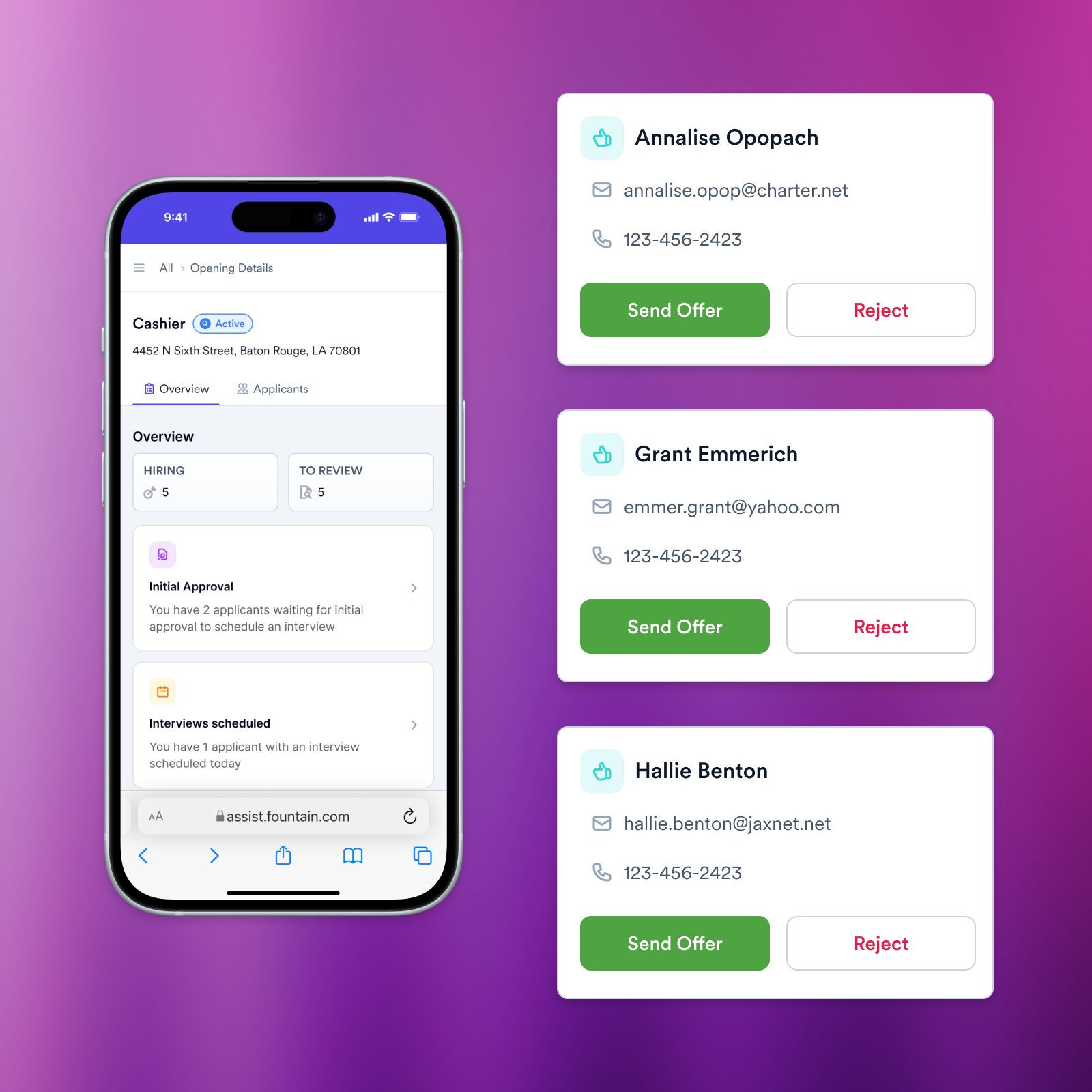
Your simple, smart, and speedy hiring solution.
Fountain knows hiring. We leverage our best in class AI to find and bring you top-tier, ready-to-work talent. We use our expertise to build personalized plans tailored specifically to your needs.
| Lifecycle stage | Top compliance artifacts | Key deadline |
| Hiring | EEO-safe job posting, FCRA disclosure and adverse-action notices, background check | Before the offer; adverse action follows the FCRA sequence |
| Onboarding | Form I-9 (Sections 1 and 2), W-4, state new-hire report | I-9 Section 1 by Day 1, Section 2 within 3 business days, new-hire report within 20 days |
| Active employment | Worker classification records, FLSA wage-and-hour records, OSHA injury logs | Maintained for the length of the job |
| Offboarding | Final paycheck, COBRA election notice, retained I-9 | Final pay by the state deadline; keep the I-9 3 years from hire or 1 year after separation, whichever is later |
Here’s what compliance entails:
- Hiring: Postings must be free of preference by protected class, interview questions limited to job qualifications, and background checks run through the Fair Credit Reporting Act (FCRA) disclosure and adverse-action sequence that the pre-employment screening guide lays out in full.
- Onboarding: The employee signs I-9 Section 1, the employer completes Section 2, and the W-4 is due when work starts; remote verification carries its own Department of Homeland Security (DHS) rules.
- Active employment: Worker classification, wage and overtime practices, FLSA recordkeeping, and OSHA injury logs all apply.
- Offboarding: Final pay is due by the state’s deadline, plus COBRA election notices and I-9 retention for three years from hire or one year after separation, whichever is later.
Sloppy employee onboarding creates the record gaps that surface in an audit years later, after the manager who made the mistake has moved on.
Where HR compliance gets harder for high-volume employers
High-volume employers face greater compliance risk because jurisdictional differences, repeated role templates, and turnover multiply each error across locations and workers. Minimum wages differ by state, city, and sometimes county, and you owe the highest applicable rate.
Some states add daily overtime, final-pay deadlines run from the day of termination to the next payday, and major cities enforce fair-workweek ordinances with no federal equivalent. A multi-unit quick-service operator running one onboarding packet across state lines picks up a new rule set with every location it opens.
Classification errors replicate the same way. A misclassified role at a single-site employer is one dispute; at a frontline employer, the same template repeats across hundreds of locations, so one wrong call becomes class-action exposure.
Turnover piles on: every separation starts a final-paycheck deadline, a COBRA notice, and an I-9 retention clock, and every hire starts the stack again. When a hire begins within days of applying, the I-9 window and the background-check sequence run at once, and anything manual gets skipped when a shift needs covering.
The fix is structural: trigger each compliance task at the same workflow stage that moves a candidate from application to first shift. A separate compliance review that runs after the decisions are made can’t keep pace.
Key HR compliance laws every employer should know
Every frontline employer touches a core set of federal statutes, with coverage that depends on headcount and location.
- Fair Labor Standards Act: federal minimum wage of $7.25/hour, overtime past 40 hours a week, and recordkeeping; state and local rates often run higher, so pay by worker location.
- Title VII of the Civil Rights Act of 1964: bars employment discrimination based on race, color, religion, sex, or national origin (15+ employees).
- Americans with Disabilities Act: bars discrimination against qualified workers with disabilities and requires reasonable accommodation (15+ employees).
- Age Discrimination in Employment Act: protects workers 40 and older (20+ employees).
- Family and Medical Leave Act: 12 weeks of unpaid, job-protected leave a year for eligible employees (50+ employees).
- Occupational Safety and Health Act: a workplace free of recognized hazards plus injury recordkeeping, with no minimum employee count.
- Immigration Reform and Control Act: Form I-9 verification for every new hire; E-Verify adds electronic confirmation and is mandatory for federal contractors and in some states.
- Affordable Care Act: employers with 50 or more full-time-equivalent employees must offer affordable coverage or face IRS penalties.
- Consolidated Omnibus Budget Reconciliation Act (COBRA): continued group health coverage after qualifying events like termination (20+ employees).
- California Consumer Privacy Act / Privacy Rights Act (CCPA/CPRA): rights for California workers over their personal data, enforced by the California Privacy Protection Agency.
Coverage thresholds matter for small employers, but if you operate across state lines, assume most of these apply somewhere in your footprint. This is general information, not legal advice; confirm how each rule applies to your locations with employment counsel.
What’s changed for HR compliance in 2026
Four shifts define HR compliance in 2026: tighter I-9 enforcement, a widening patchwork of state AI rules, more pay transparency, and record anti-discrimination recovery.
- Tighter I-9 enforcement: U.S. Immigration and Customs Enforcement (ICE) now treats some previously correctable errors as substantive violations with no correction window, fined as found at inspection. For high-volume employers, that raises the premium on complete, immediately producible I-9 records at every location; the form mechanics live in the I-9 verification guide.
- State AI rules in hiring: With federal guidance receding, a state and local patchwork now governs automated hiring tools. New York City requires bias audits, California’s automated-decision-system regulations took effect October 1, 2025, Illinois and Texas statutes followed on January 1, 2026, and Colorado’s AI Act takes effect January 1, 2027. Title VII, the ADA, and the ADEA still apply in full to any hiring decision involving AI.
- More pay transparency: More jurisdictions now require a pay range in the job posting itself, so employers hiring frontline roles nationally need location-specific posting checks.
- Record anti-discrimination recovery: The Equal Employment Opportunity Commission (EEOC) recovered $528 million for 13,351 workers through pre-litigation enforcement in fiscal 2025, its highest total in 60 years. At volume, consistent and documented decision criteria, and routing sensitive discipline and termination calls to counsel, are what hold that exposure down.
The enforcement and anti-discrimination landscape keeps shifting, so confirm your obligations in any specific jurisdiction with employment counsel.
How technology supports compliance workflows
Software helps here mainly by making deadlines hard to miss: automated workflows trigger the right form at the right stage, track documents as they come in, flag closing windows, and keep a per-location audit trail you can produce on demand, with one view of which locations are behind.
Weighing one compliance system against another is its own decision. Technology supports compliance workflows and audit readiness, not the judgment calls; employers remain responsible for hiring, discipline, and legally sensitive decisions.
How Fountain builds compliance into frontline hiring
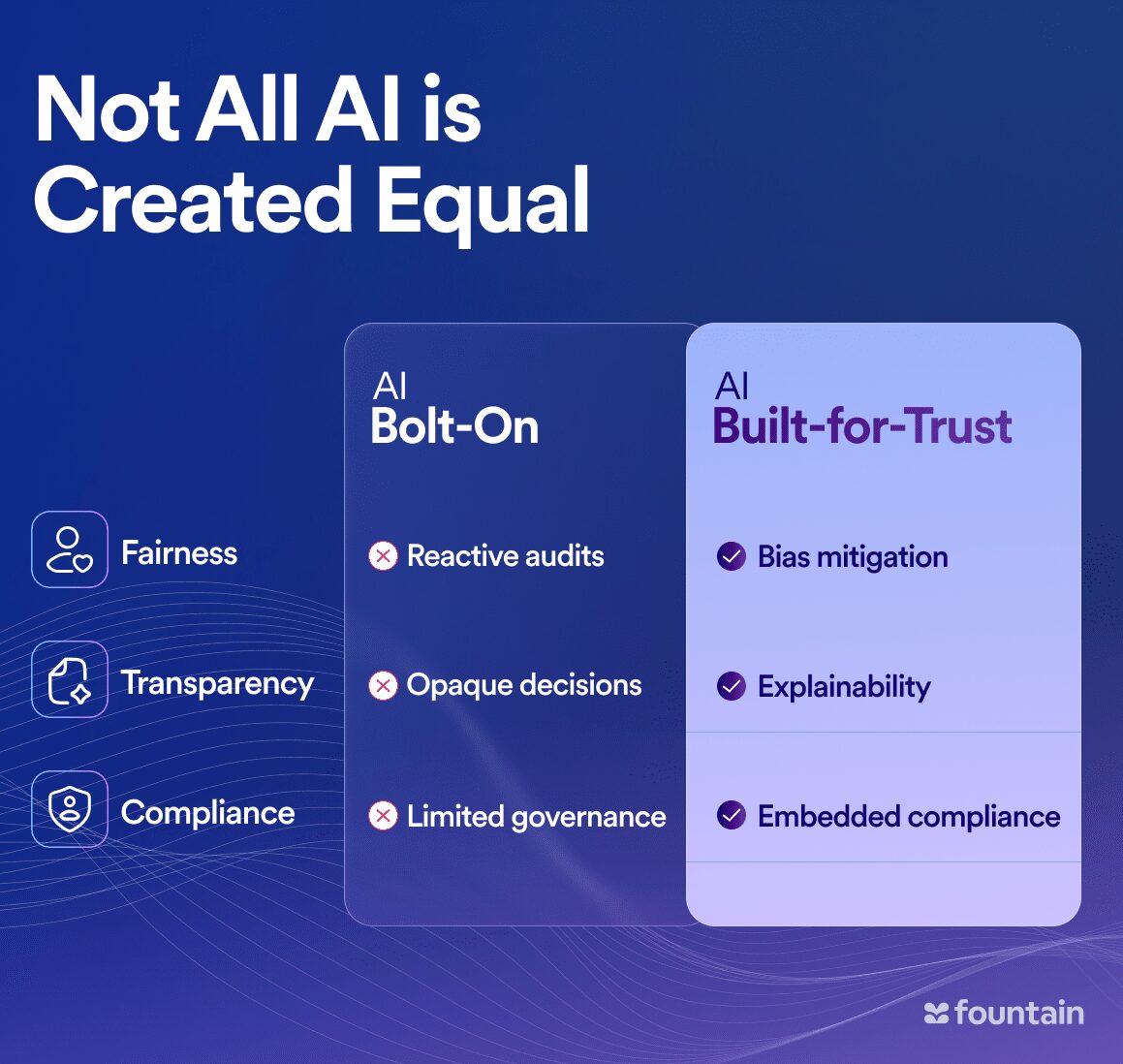
Rising penalties turn invisible paperwork gaps into visible financial exposure, and a spreadsheet can’t keep pace across hundreds of locations. Fountain attaches each required form, deadline, and record to the workflow step that triggers it, so a location that falls behind is visible before an inspector finds it.
Cue, the orchestration layer across every Fountain product, is the entry point: ask it to “set up onboarding for 40 new Texas and California locations with I-9, W-4, and state new-hire-reporting steps,” and it builds the location-specific flows and deadline triggers for human review before launch.
Emma, Fountain’s I-9 and W-4 consultant, walks each new hire through onboarding paperwork and clears blockers before they stall a start date, while Anna, the AI Recruiter, runs first-round screening and Sam tracks post-hire sentiment for managers to act on. Emma guides and routes; the employer reviews, approves, and stays liable.
Fountain Onboarding and its I-9 Center trigger I-9, W-4, and E-Verify steps with e-signature, auto-fill the fields they already hold, and surface errors while the worker is still on the form. Compliance reporting shows which sites still have open forms and which I-9 windows close next, so the full record set is producible inside the three-business-day window an inspection allows.
Obligations still attach to every location you hire in; what changes is whether a manager has to hold all of them in their head.
See it on a live workflow: book a demo to hand Cue a new-state onboarding rollout, watch Emma clear a hire’s I-9 and W-4, and pull an audit-ready record for any location on demand.
Frequently asked questions about HR compliance
Who is responsible for HR compliance?
HR owns the policies, workflows, and records, but execution happens wherever hiring happens. Frontline managers complete I-9s, run interviews, and post schedules, so training and standardized workflows matter as much as the policy itself. Employment counsel should review legally sensitive matters, including audit responses and classification decisions.
How long do employers need to keep Form I-9?
Three years after the employee’s Day 1 or one year after employment ends, whichever is later. Forms must also be producible within three business days of an inspection notice, so retrieval matters as much as retention.
What happens if a company isn’t HR compliant?
Consequences include back-wage orders, per-violation fines, discrimination charges, and class litigation. I-9 paperwork violations are fined per form, so exposure scales with headcount. Beyond the direct costs, failed audits consume management time and damage the employer brand frontline hiring depends on.