Philadelphia requires 9 hours between a closing shift and an opening shift and charges a flat $40 when the gap runs short. Chicago requires 10 hours and pays 1.25 times the entire affected shift. New York City fast food requires 11 hours and a flat $100. All three require 14 days’ notice. No two of them handle the rest gap the same way.
These laws were written city by city, and a chain with stores in three of them runs three notice rules, three premium formulas, and three rest gaps off one schedule. What follows is general information rather than legal advice.
What predictive scheduling laws are, and why frontline employers hit them first
Predictive scheduling laws require covered employers to publish schedules in advance, pay a premium when a posted schedule changes on short notice, protect a minimum rest gap between shifts, and offer newly available hours to existing part-time staff before hiring externally.
“Fair Workweek” is the same category under the name most ordinances use, and both grew out of the backlash against just-in-time scheduling.
Coverage is written industry by industry, and the lists are not accidental. Oregon names retail, hospitality, and food services, Seattle names retail and food service, and the Chicago-family ordinances add warehouses, manufacturing, hotels, building services, and healthcare.
Frontline employers are not incidentally caught by these statutes. They are named in them.
Where predictive scheduling laws apply in 2026
One statewide law in Oregon and 10 local ordinances. New York City runs fast food and retail as separate regimes, so the table carries 12 rows and a multi-location operator schedules against 12 rule sets. San Jose’s Opportunity to Work is an access-to-hours law, not a scheduling law, though most lists include it.
| Jurisdiction | Covered industries | Size threshold | Advance notice | Effective date |
| Oregon (statewide) | Retail, hospitality, food services | 500+ worldwide | 14 days | July 1, 2018 |
| Seattle, WA | Retail, food service | 500+ worldwide; full-service restaurants also 40+ locations | 14 days | July 1, 2017 |
| San Francisco, CA | Formula retail | 40+ locations worldwide and 20+ employees in SF | 14 days | July 3, 2015 |
| Emeryville, CA | Retail, fast food | 56+ globally; fast food also 20+ in Emeryville | 14 days | July 1, 2017 |
| Berkeley, CA | Building services, healthcare, hotels, manufacturing, restaurants, retail, warehouses | 10+ in Berkeley; 56+ globally, 100+ for restaurants | 14 days | Jan. 12, 2024 |
| Los Angeles City, CA | Retail only | 300+ globally | 14 days | April 1, 2023 |
| Los Angeles County, CA (unincorporated) | Retail only | 300+ globally | 14 days | July 1, 2025 |
| Philadelphia, PA | Retail, hospitality, food service | 250+ employees and 30+ locations | 14 days | April 1, 2020 |
| NYC fast food | Fast food chains | 30+ locations nationally | 14 days | Nov. 26, 2017 |
| NYC retail | Retail | 20+ workers in NYC | 72 hours | Nov. 26, 2017 |
| Chicago, IL | Building services, healthcare, hotels, manufacturing, restaurants, retail, warehouses | 100+ globally and 50+ covered employees; restaurants 250+ and 30+ locations | 14 days | July 1, 2020; rules revised June 1, 2026 |
| Evanston, IL | Hospitality, food service, retail, warehouses, manufacturing, building services | 100+ globally; food service 200+ and 30+ locations, under 4 locations excluded | 14 days | Jan. 1, 2024 |
Two rows get collapsed more often than the rest.
- New York City is two laws, and they differ on almost everything. Fast food gets 14 days, dollar-tier premiums, and just-cause discharge protection. Retail gets 72 hours, no premiums, and an outright on-call ban, so workers have to be assigned to the right rule set before a schedule posts.
- The two Los Angeles ordinances cover retail only, and the county rule reaches unincorporated territory alone. A store in Long Beach or Pasadena falls under neither, which is why multi-store retail workforce planning starts from a jurisdiction map, not a headcount forecast.
Preemption is the flip side of the same map, and where competing pages fail most.
Nine states have statutory text blocking local scheduling ordinances:
- Arizona
- Georgia
- Iowa
- Kansas
- Michigan
- Ohio
- Florida, which names predictive scheduling outright
- Texas, whose HB 2127 survived a 2025 challenge on standing rather than the merits
- Oregon, whose ORS 653.490 makes the only statewide law a preemption state too
Nothing new has been enacted since: Connecticut’s SB 436 cleared committee in March 2026 and then died on the Senate calendar, New Jersey’s S2664 sits in Senate Labor, and the federal Schedules That Work Act has not moved since December 2025.
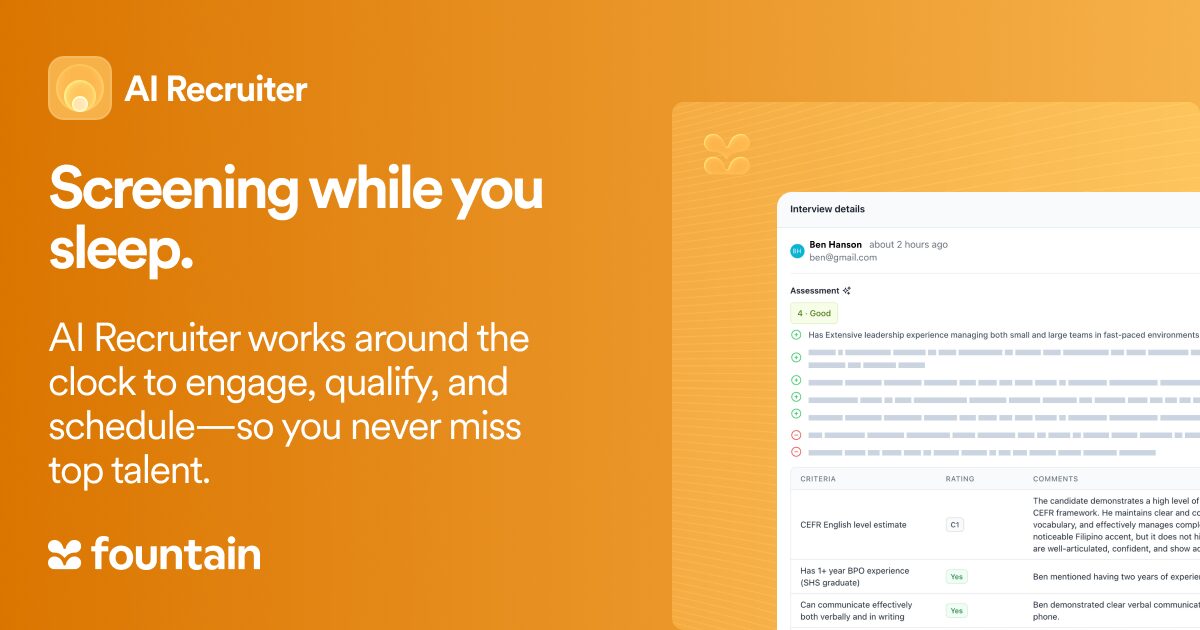
See How Fountain’s AI Recruiter Uses Agentic AI to Cut Screening Time by 79%
Fountain’s AI Recruiter leverages Agentic AI to transform how hiring gets done—screening candidates, scheduling interviews, and surfacing insights automatically. No prompts. No bottlenecks. Just faster, smarter, always-on hiring.
If your team is stretched thin or struggling to keep up with high-volume roles, now’s the time to see what Agentic AI can do.
What the laws require, and where they diverge
These laws share four obligations, and three have no single national formula:
1. Advance notice and good-faith estimates
Every regime except NYC retail requires 14 days’ notice. Philadelphia phased in, 10 days through 2020 and 14 days from January 1, 2021.
Most ordinances also require a written good-faith estimate of hours at or before hire, and the contents differ: median weekly hours in Seattle, median monthly hours plus the standby list in Oregon, average weekly hours across the first 90 days in Philadelphia. New York City is the exception, because it has no good-faith estimate at all.
The fast food version was replaced on July 4, 2021 by a mandatory written regular schedule, and retail never had one.
2. Predictability pay
Predictability pay runs on four structurally different models, so the same 24-hour change produces four different payroll entries depending on the store.
- Six jurisdictions owe an extra hour of pay plus half-time for hours lost. Seattle, Philadelphia, Chicago, Oregon, and both Los Angeles jurisdictions pay 1 hour for a changed or added shift plus half pay for hours the employee loses. Chicago tiers that second piece by whether notice exceeded 24 hours.
- New York City fast food owes flat dollars rather than hours. Premiums run $10 to $75 per change, keyed to how late it came and whether the worker lost hours, regardless of wage rate.
- San Francisco owes 1, 2, or 4 hours depending on notice and shift length. Picking the right FRERO tier takes the shift length and the change timestamp together.
- New York City retail owes nothing and prohibits the changes instead. On-call shifts are banned outright, and a regular shift generally cannot be cancelled, added, or confirmed inside 72 hours without written consent.
Payroll therefore needs jurisdiction, elapsed notice, minutes changed, and hours lost per event, not a net schedule delta at period close.
3. Rest gaps and clopening
A clopening is a closing shift followed too soon by an opening shift. The protected gap is 9 hours in Philadelphia, 10 in Oregon, Seattle, Chicago, and both Los Angeles jurisdictions, and 11 in NYC fast food, Berkeley, Emeryville, and Evanston. San Francisco and NYC retail have no rule at all.
The premium takes four forms: time and a half in most places, a flat $40 per shift in Philadelphia, a flat $100 in NYC fast food, and 1.25 times the entire affected shift in Chicago, where the trigger is working the short-gap shift rather than declining it, so written consent does not remove the obligation.
Los Angeles city and county split that multiplier differently, the city over the whole second shift, the county over the gap hours alone. One clopening flag cannot carry all of that.
4. Records and posting
Retention runs 2 years in Philadelphia and 3 years in Seattle, San Francisco, Chicago, Oregon, Evanston, and Los Angeles County. Notice duties diverge too: Oregon requires a conspicuous poster and lets employees decline any shift not on the posted schedule, Chicago requires notice with the first paycheck, and New York City requires it in the primary language of any group at 5% or more of a worksite.
The two requirements a scheduling tool cannot satisfy
Two of these obligations exist before a schedule does, which is why they land on hiring, not on scheduling software.
The good-faith estimate is a hiring document, due before hiring in Los Angeles city and county, at the time of hire in Oregon, and on or before the first day in Chicago and Evanston. An estimate produced after the first schedule posts is already late, so the control belongs in the hiring flow.
Right of first refusal gates the requisition.
- San Francisco sends available hours to existing part-time staff before anyone else. The offer goes out in writing or by posting, capped at 35 hours a week, records kept 3 years, and Emeryville adds a 72-hour window to accept.
- Philadelphia treats a missing offer record as a presumption of violation. The written offer has to be posted at least 72 hours, so verify the posting period and its record before approving a requisition.
- Evanston and Chicago make opening the requisition the violation. Both prohibit external hiring before the internal offer runs, and Chicago’s ordering puts current covered employees first, then temporary and seasonal workers.
Neither artifact can come from a system that starts at the schedule, because both are created upstream of where scheduling tools built for compliance at build time reach. Agentic compliance orchestration can draft the estimate, flag a missing offer record, and route the exception for a manager to approve.
What getting it wrong costs
Exposure scales on multipliers, not a headline fine: affected employees, pay periods or days the violation stands, and whether the money goes to the city or the worker.
Chicago fines run $300 to $500 per offense, with each affected employee and each day a separate one. New York City’s fast food penalties run $500, then up to $750 for a second violation inside two years and up to $1,000 after that, per employee and per instance. Philadelphia’s presumed damages run $25 to $1,000 per impacted employee per pay period, the top tier for failing to award available hours.
Those multipliers compound before anyone files a complaint. Schedules and annual caps vary by jurisdiction, so confirm your own exposure with counsel.
Worker restitution is usually the larger track. Starbucks settled with New York City’s consumer and worker protection department in December 2025 for $38.9 million under the Fair Workweek Law, $35.5 million of it restitution to over 15,000 workers. Seattle’s Office of Labor Standards resolved a Secure Scheduling case against Thacher Restaurant Group LLC dba Wingstop with $97,466.45 in remedies to 293 workers and $332.65 to the city.
One mis-posted schedule across 40 stores multiplies by every covered employee on it, then again by every pay period it stands, and seasonal ramps are where that math turns fastest.
Posting further out is the cheaper control, and it doubles as one of the strongest frontline retention levers available.
How Fountain runs hiring and scheduling on one system
Fountain brings hiring and scheduling together through Frontline Superintelligence, and Cue is the orchestration layer an operator talks to. A Chicago operations lead can type “flag every change to next week’s Chicago schedules inside the 14-day notice window, calculate the predictability pay owed, and route each one to the store manager.” Cue builds and runs that workflow, and the manager signs off before anything reaches payroll.
Three live agents carry the repetitive work. Emma clears document blockers before Day 1, the window the good-faith estimate closes in. Anna runs voice screening around the clock, keeping the roster deep enough that short-notice changes stop being the default coverage tool. Sam surfaces retention signals before a no-show forces a change on 24 hours’ notice.
The products map to the obligations above. The ATS and Onboarding hold the offer-stage good-faith estimate and the internal-offer record, each with an audit trail. Shift & Scheduling applies break, overtime, and coverage rules per location and flags gaps before they become short-notice changes.
The CRM rebuilds coverage from alumni and past applicants who already cleared screening, often faster than a requisition that has to clear an internal-offer window. With Fountain, Bojangles reported time-to-hire falling from around 30 days to 5.8 days across 750 locations.
The chain with stores in Philadelphia, Chicago, and New York City is not running one compliance problem three times. It is running three, and the two that matter most were created before anyone opened the schedule.
See it on a live workflow: Book a demo and trace a good-faith estimate through Onboarding, an internal-offer record through the ATS, and a clopening exception through Cue.
Frequently asked questions about predictive scheduling laws
What is predictive scheduling?
Predictive scheduling is the practice of publishing work schedules a fixed period in advance, typically 14 days in regulated jurisdictions, and paying a premium when the schedule changes after it posts. Because New York City runs fast food and retail separately, 2026’s 11 jurisdictions amount to 12 distinct rule sets.
Are predictive scheduling laws federally mandated?
There is no federal predictive scheduling standard. Every active rule is a state, city, or county law: Oregon statewide plus 10 local ordinances, while nine states block their cities from passing any.
What is predictability pay?
Predictability pay is the premium owed when an employer changes a posted schedule inside the notice window, and the formula varies by jurisdiction: an extra hour plus half-time for cancelled hours in six jurisdictions, fixed tiers of $10 to $75 in New York City fast food, 1, 2, or 4 hours in San Francisco, and no premium at all in New York City retail.