The global business process outsourcing market reached an estimated $328.4 billion in 2025 and is projected to approach $695.8 billion by 2033, a compound annual growth rate of 9.9%. Companies increasingly use outsourcing to add staff or specialist skills without building an internal team for the work.
For most growing companies, the real questions are which functions to hand off and how to structure the arrangement so quality and cost stay under control. Get it wrong in a frontline operation and the cost is immediate: when sites can’t fill shifts fast enough, managers leave the floor to recruit and service slips.
What is outsourcing?
Outsourcing is contracting a business function or process to an outside provider instead of running it with internal staff. The provider brings its own people and methods, and the company pays for the output rather than employing the team that produces it.
The arrangement can be a one-off project, like a website build, or an ongoing function like payroll processing, where the provider runs the process indefinitely and governance matters more because the relationship never ends.
Why do companies outsource?
Companies outsource to get capability they can’t build fast enough or run cheaply enough in-house.
Deloitte’s 2024 Global Outsourcing Survey of more than 500 business and technology leaders shows how the reasons have shifted, and they fall into four groups.
- Cost: Outsourcing turns fixed headcount into variable spend and sheds the overhead of full-time employees, but it no longer leads the list. Only 34% of executives cited lowering costs as a primary driver in 2024, down from 70% citing cost reduction in 2020, so leaders should weigh talent and speed alongside savings rather than treat labor rate as the whole case.
- Speed and scale: A provider can stand up coverage faster than a hiring plan allows and then flex it as demand moves, which is why 23% of executives named the ability to add or reduce outsourced staff as a primary driver. Before signing, compare ramp time and minimum commitments, and read the contract for flex-down restrictions instead of focusing only on labor rates.
- Access to expertise: Improved access to talent led the 2024 survey at 42%, ahead of every other reason. Buying specialist skill for the hours you need it beats hiring for it full-time.
- Focus on core work: Handing off context work puts internal hours back on what actually differentiates the business. More than half of organizations (56%) now outsource front-office functions like customer service and order fulfillment, about 10 points higher than in 2022, so those functions increasingly belong on the list of partner candidates rather than automatically staying in-house.
The through-line is flexibility: doing more without carrying all of it as fixed cost. That pull is durable, with 40% of executives planning to increase their outsourcing investment and only 20% planning to cut it, so procurement teams need a repeatable way to manage vendors and preserve the option to leave, not a one-time purchase.
What are the types of outsourcing?
Outsourcing can be onshore, nearshore, offshore, or onsite. These labels describe where the provider does the work, and they are often confused with offshoring. Outsourcing is about who does the work, an outside company, while offshoring is about where it happens, another country.
As the U.S. GAO frames it, a company can offshore work to its own foreign affiliate without outsourcing anything, or outsource to a provider down the street.
- Onshore: A provider in your own country, sometimes called domestic sourcing, even when it works from another city or state.
- Nearshore: A provider in a nearby country or time zone, such as a U.S. company working with a team in Mexico or Canada.
- Offshore: A provider in a distant country, often chosen for cost and labor-pool reasons.
- Onsite: An outside provider whose people work from your locations rather than theirs.
These geographic labels overlap with function-based labels like BPO (business process outsourcing) and IT outsourcing, so a contract can be both. A “nearshore BPO deal” just means a business process handled by a provider in a neighboring country.
What do companies commonly outsource?
Some functions outsource well because they are specialized, repeatable, or spiky in demand, while core strategy rarely does. The SBA’s list of commonly outsourced small-business functions covers most of them.
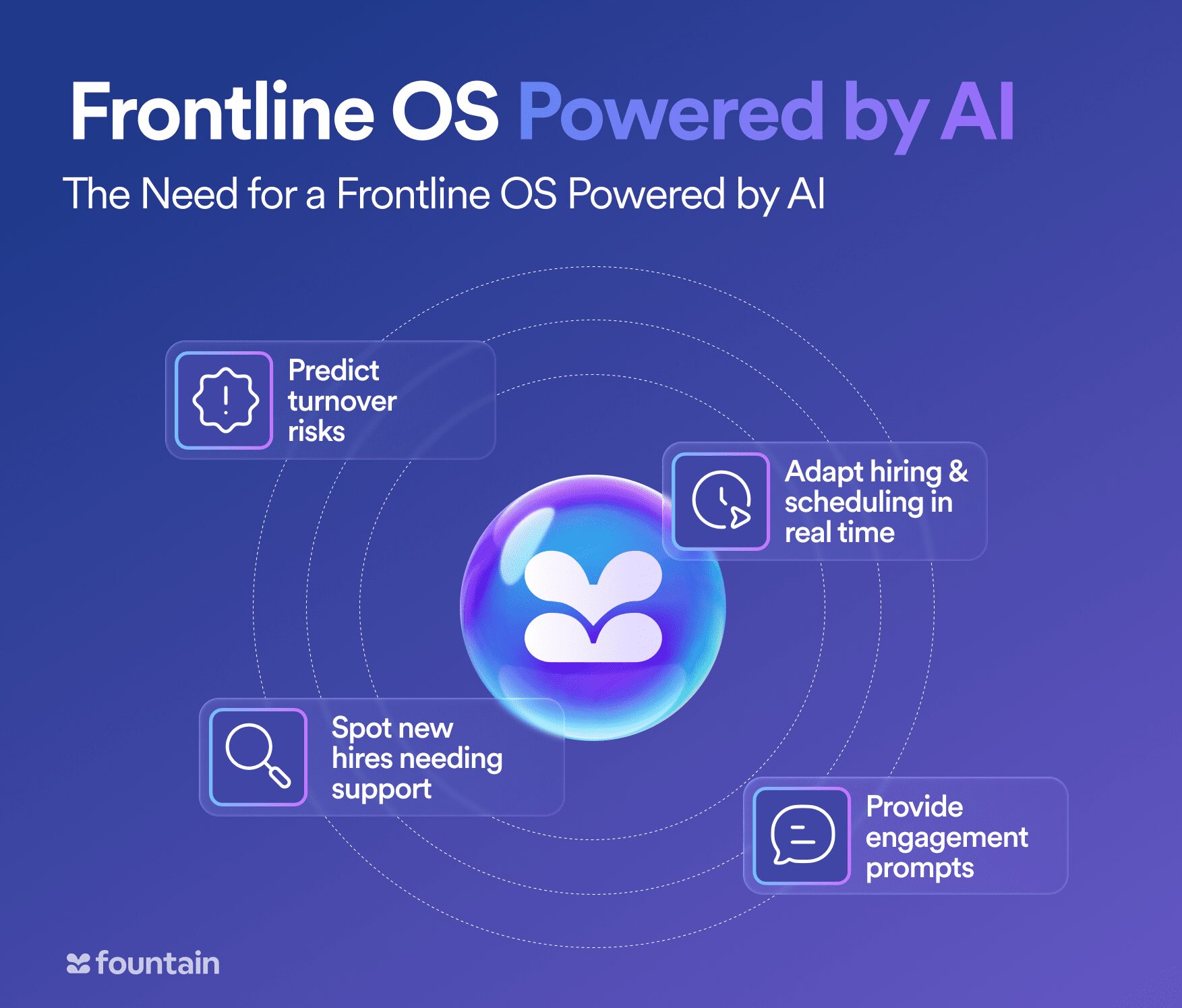
A smarter, connected way to hire, engage, and retain frontline teams
Centralize scheduling, hiring, onboarding, engagement, and analytics in one AI-powered platform built for the frontline workforce. Fountain OS gives leaders the real-time insights and tools they need to predict turnover, boost retention, and streamline high-volume operations.
Automate repetitive tasks, identify at-risk employees early, and make data-driven workforce decisions with a unified solution designed to help frontline teams thrive.
- IT and software: Help desks, application development, and infrastructure. Slack outsourced both its marketing website design and its web and mobile app development to MetaLab.
- Customer support: Contact centers and overflow coverage for seasonal volume. Teleperformance runs customer experience for enterprises at global scale, but that footprint only matters if it matches your required languages, time zones, and escalation coverage, so map those needs before comparing providers.
- Finance and accounting: Bookkeeping, payroll processing, and accounts payable and receivable. Accounting is one of the most commonly outsourced functions, which makes it a sensible first standardized, specialist process to hand off before less repeatable work.
- Logistics and fulfillment: Warehousing, last-mile delivery, and full third-party logistics (3PL) relationships. As shippers lean more on outsourced logistics, compare 3PL capacity, total cost, governance, and exit terms before demand forces a rushed selection.
- HR and recruiting: Benefits administration and hiring itself, through staffing firms or recruitment process outsourcing. The American Staffing Association defines RPO as transferring all or part of the recruitment process to an external provider that may supply its own staff, technology, and methods.
Recruiting is where this gets concrete for hourly employers.
Frontline, high-volume hiring is now the main growth driver for RPO, and many providers are still adapting delivery models built for professional roles, so hourly employers should test whether an RPO can actually handle frontline application volume, rapid screening, multi-site scheduling, and onboarding before assuming a professional-hiring model transfers.
What are the risks of outsourcing and how can you manage them?
Outsourcing trades some control for capacity and flexibility, and every major risk traces back to that trade. Each one has a known mitigation, and most of that work happens before you sign.
- Data security: Third-party involvement in breaches has roughly doubled, to nearly 30%, in the 2025 Verizon Data Breach Investigations Report. The provider’s SOC 1 and SOC 2 reports are the baseline check, and data-protection and audit rights belong in the contract itself.
- Communication and distance: Agree explicitly on meeting cadence and overlap hours up front, or you will argue about them in month three. Cultural fit deserves the same attention, because it shows up in daily handoffs rather than in the SLA.
- Loss of control and lock-in: Hand over a whole capability blind and switching costs become prohibitive. Documenting workflows and integration points during the engagement preserves the option to leave, and exit terms get negotiated before signature, not at renewal.
- Hidden costs: Management overhead, contract administration, and the eventual cost to switch all belong in the business case alongside the vendor’s quoted rate.
Companies that scope tightly and keep a documented exit path get the flexibility without losing their grip on quality. The fix is never to avoid outsourcing; it is to scope it and govern it.
Outsourcing vs. offshoring vs. contractors vs. agencies vs. in-house
Outsourcing uses an outside provider to deliver an outcome. Offshoring changes where the work happens, contractors are engaged directly, agencies fill openings, and in-house work stays with your employees.
| Model | What it is | How it differs from outsourcing |
| Offshoring | Moving work to another country, including to a company’s own foreign affiliate | A location choice; the work can stay fully in-house |
| Independent contractors | Self-employed individuals engaged directly, who control how they perform the work | No provider organization in between; misclassification carries legal and tax risk under IRS and DOL tests |
| Staffing and recruiting agencies | A partner that sources or places workers for a fee | Fills specific openings transactionally, while RPO takes ownership of the recruiting process itself |
| In-house | The company’s own employees and infrastructure | Full control, and full fixed cost |
Geoffrey Moore’s core-versus-context test settles most of these calls: core work creates competitive advantage and stays inside, while context work has to get done but doesn’t differentiate the business, which makes it a candidate for a partner.
If your open question is whether to use a recruiting agency or hire in-house, start there; if it is the broader contingent workforce question, that is where staffing-firm models, VMS, and direct sourcing get compared.
How Fountain runs frontline hiring at outsourcing speed
Frontline hiring can run at outsourcing speed whether you keep it in-house or hand it to a staffing or RPO partner: Fountain powers both, with companies running their own hiring on it and staffing and BPO firms running client hiring on it.
Cue, the orchestration layer and single entry point to the agents, turns a goal like “Screen 200 associates across our 12 sites this week” into sourcing, screening, and scheduling work, with managers approving offers and exceptions.
Anna runs voice screening 24/7, Emma handles candidate questions and I-9 and W-4 paperwork, and Sam flags early quit risk, all on one record across the ATS, Sourcing, CRM, Onboarding, and Shift & Scheduling. Fountain works alongside your HCM and payroll, not in place of them, and is not an outsourcing provider.
Turas Group, a staffing agency, cut time-to-hire 78%, from 14 days to 3; Marsden Services cut a client’s vacancy rate from 18% to 6%. Whichever path you pick, judge it on the same numbers: book a demo to benchmark your sites against Anna’s screening and Cue’s orchestration.
Frequently asked questions about outsourcing
What is outsourcing in simple terms?
Outsourcing is paying an outside company to handle work your own staff would otherwise do. It ranges from a one-time project, like building a website, to an ongoing function the provider runs permanently, like payroll or a customer support line.
What is the difference between outsourcing and offshoring?
Outsourcing describes who does the work, an outside company. Offshoring describes where the work happens, another country. You can outsource domestically, offshore work to your own foreign subsidiary, or do both at once through offshore outsourcing.
Why do companies outsource?
Access to talent is now the leading reason, ahead of cost savings, according to Deloitte’s 2024 survey of more than 500 business and technology leaders. Companies also outsource to convert fixed headcount into variable spend, add capacity faster than hiring allows, and keep internal teams on the work that differentiates the business.
Disclosure: We provide Frontline Superintelligence for companies running frontline hiring in-house, and many staffing and BPO firms run client hiring on Fountain too. We are not an outsourcing provider.