A shift opens at 2 p.m. for a 10 p.m. start. The manager covering it thumbs through a personal contact list and a half-dead group text and hopes the right person answers before the night crew clocks in short. Every best practice for communicating open shifts comes back to one thing: how fast an offer reaches an available, qualified worker on a channel that worker actually checks.
When managers rely on calls and texts instead of a shared workflow, that scramble is the result. These practices apply to frontline, shift-based work on retail floors, restaurant lines, warehouse docks, and care units.
What an open shift is, and why communicating it is the real bottleneck
An open shift is an unassigned shift that still needs a qualified worker. Coverage depends on getting the offer to an eligible worker in time to accept it. Employee turnover creates open shifts; so do callouts and no-shows, demand spikes, and seasonal surges.
For operators who already run a base schedule, the hard part isn’t building it. It’s covering the gaps that open after it publishes, fast enough and on the right channel.
Understaffing is expensive in ways that surface on different lines of the business. Among restaurant operators reporting hard-to-fill openings, it shows up as higher overtime, weaker service, and lost sales, per Fountain’s 2025 QSR Workforce Snapshot Report.
In hospitals it shows up in patient outcomes: one large study from 2026 found day-shift mortality ran 3.2% on understaffed units against 2.8% on adequately staffed ones. An open shift that never reaches the right person becomes overtime for whoever stayed, thinner coverage for customers, and a worse night for everyone on the floor.
Why phone trees, group texts, and email break down at frontline scale
The default tools were built for a workforce that sits at a desk. Frontline workers don’t. They frequently lack access to workplace communication channels and digital tools, so a message to the company inbox may never reach them in time, and a paper schedule stops existing the moment a worker leaves the building.
Phone trees and manager call-arounds don’t scale either. A manager working down a contact list can only reach the people on it, and across a multi-site footprint those calls land on the same short list of people the manager trusts to say yes. Coverage ends up only as wide as one manager’s phone.
Large, untargeted group texts fail differently. When every offer goes to everyone, workers mute the thread and the one that mattered drowns in the noise. There is also nothing to produce when a dispute surfaces, which matters in jurisdictions where shift changes carry legal notice requirements.
What closes the gap is keeping open-shift communication in a workflow the business can target, search, and reconstruct.
Channels that actually reach frontline workers
The channels that work are the ones already in a worker’s pocket. SMS leads on speed, since texts get read within minutes. For urgent gaps, a workforce app’s push notifications or WhatsApp work where WhatsApp is already a normal employee channel. Email rarely suits an urgent gap, and a phone call only works if someone picks up.
Smarter, faster, and more compliant from day one
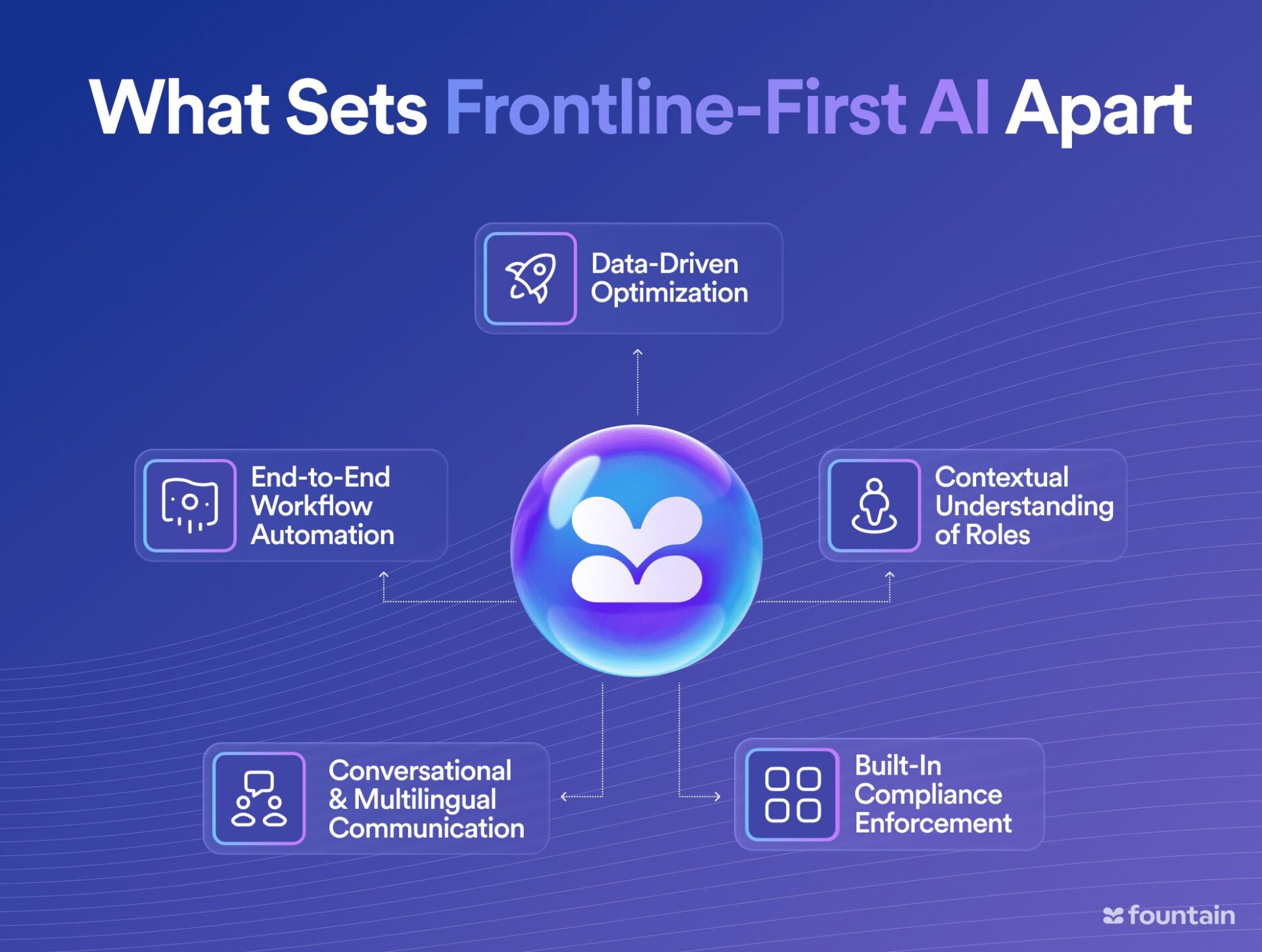
See how frontline-first AI helps you reduce time-to-hire, engage more candidates, and stay compliant at scale.
From instant chat-based screening to automated scheduling and built-in compliance, Fountain’s AI gives your team the tools to hire faster and smarter while maintaining accuracy and a great candidate experience.
Schedule a personalized demo and explore what’s possible.
Channel choice is only half the design; the other half is matching a message’s prominence to its urgency. When every alert looks the same, too many of them train people to tune all of them out, including the one that matters. A same-day gap should go out as a real-time broadcast to the eligible pool over SMS or push, with a claim action attached.
Next Saturday’s opening belongs in a scheduled digest or an in-app feed, where nobody’s phone buzzes at 6 a.m.
Match the channel to the timing:
- Same-day gaps: SMS or push notifications with a claim action.
- Future openings: a scheduled digest or in-app feed.
- Routine updates: email, where an immediate response isn’t required.
The controls that speed up filling a shift are the same ones that keep workers from being spammed. Blasting every opening to the full roster might fill tonight’s shift, but it makes every future alert easier to ignore.
Targeting offers to eligible workers, tiering them by urgency, and testing per-worker offer limits are what keep the channel worth opening a month from now.
The broadcast-to-claim workflow, and who hears about the shift first
One workflow replaces the phone tree: a manager publishes the open shift, the eligible pool is notified, workers claim or bid, the claim routes to a manager for approval, and the system confirms back to whoever got it and the ones who didn’t. The steps in order:
- Publish the open shift.
- Notify the eligible pool.
- Collect claims or bids.
- Route the claim for manager approval.
- Confirm the outcome to workers.
Every step needs a clock on it, because hourly workers take the first offer they get. Gig platforms have trained people to run several apps at once, and multi-apping is common, so an offer that arrives an hour late often arrives after the worker has already committed elsewhere.
Who hears about a shift first is a real decision, not a default. Blasting every opening to everyone is fast but noisy and can feel unfair; routing them to a favored few is quiet but burns the same people out.
Notice itself is a retention issue: turnover reached 39% among workers given less than 72 hours of schedule notice, against 24% for those with two or more weeks. So reserve real-time alerts for genuine same-day gaps and publish planned openings as early as you can.
Between those extremes sit a few controls, applied in order:
- Check eligibility and credentials first, since regulated work can require verified credentials before assignment.
- Apply rotation or seniority rules next, so extra hours spread across the roster instead of pooling with favorites.
- Set deadlines and per-worker limits to keep the process predictable.
The system can surface the eligible pool and route the claim, but a manager approves the assignment and decides the exceptions.
Two-way communication beats one-way blasts
An offer that only travels one direction fills tonight’s gap and nothing after it. Give workers a fast way to accept, decline, ask a question, or flag a conflict without calling the manager. A decline reason tells the team how to make the next offer better; silence leaves the manager with nothing to act on.
Communication quality is a real retention lever, not a nicety. In Staffbase’s 2025 study of deskless workers, only about 10% said they were happy with the quality of workplace communication. Asking for input and visibly acting on it is part of the job, not an extra.
Flexible scheduling and real worker input into the schedule are among the strongest retention levers for deskless teams, and among the most underused. A light post-shift feedback loop, even a one-tap prompt, tells you whether the offer process is actually working or merely running, and shows workers that their answers change something.
The metrics that tell you it’s working
Fill rate tells you whether shifts got covered. The other three tell you why.
- Fill rate: The share of open shifts covered within a set window. The consistency of the definition matters more than the number, because “assigned at the planning cutoff” and “covered at shift start” are different outcomes and belong in separate measures.
- Shift-coverage time-to-fill: The clock from when a shift opens to when a qualified worker is confirmed. Same-day gaps deserve their own baseline, apart from planned openings.
- Notification response rate: the share of notified workers who take any action, accept or decline. It separates a message problem from a channel problem.
- Post-claim show rate: the share of claimed shifts where the worker actually appears. A high fill rate with a weak show rate means claims are being made and not honored.
Read each number against the same location’s own history, segmented by shift type and time of day, rather than against an outside benchmark. That is what tells you whether overnight shifts are carrying most of the no-shows.
Where automation helps, and the line it has to respect
Automation should carry the repetitive parts of coverage:
- Watching for the coverage gap.
- Assembling the eligible, qualified pool.
- Broadcasting on each worker’s preferred channel.
- Routing the claim to the right approver.
Done by hand, that work is expensive. In the Workforce Institute’s study of coverage management, supervisor productivity fell 15.7% while the co-workers covering the gap ran 29.5% less productive. Automating the matching and routing takes the manual calls and response-tracking off the manager’s plate.
The line is judgment. Managers keep approval over overtime, credential exceptions, and premium pay, and the point of that gate is to spend attention where the risk lives. Asking a human to bless every routine action instead of the risky ones just dulls the oversight you wanted.
Compliance may shape part of that line too. Some cities and states, including Oregon, have predictive scheduling or Fair Workweek rules that can affect how much notice an open-shift offer requires and what a late change may cost, and the specifics vary widely by jurisdiction and change over time.
Fountain’s guide to predictive scheduling laws gives a high-level overview, not legal guidance. None of this is legal advice: because the rules differ by location, confirm what applies to your sites with qualified employment counsel before you rely on it or automate workforce texts.
How Fountain runs open-shift communication on one system
Fountain runs open-shift communication on the same system that handles hiring and onboarding, so the offer, the roster, and the worker record never drift apart. Cue, the orchestration layer of Fountain’s Frontline Superintelligence, takes the objective in plain language. A shift lead might type: “Fill every open shift at the Northgate store this weekend with cross-trained staff.” Cue runs the workflow and routes the result, and a manager still approves every coverage change and exception.
Cue coordinates a roster of agents, all live today:
- Emma answers the round-the-clock questions an open-shift offer generates, so a worker deciding whether to claim a shift gets an answer at 11 p.m. without waiting for the manager.
- Sam runs post-shift check-ins and surfaces the retention signals that show up before a no-show does.
- Anna keeps the roster deep with round-the-clock voice screening, so open shifts have willing takers in the first place.
Underneath, Shift & Scheduling handles the coverage-gap detection, eligibility matching, mobile claim, and approval gate. The edge no standalone scheduling tool can match comes from one shared worker record: when the internal bench can’t cover a shift, CRM re-engages recent alumni and past applicants and Sourcing reaches the wider pool, while the ATS and Onboarding get new hires shift-ready without re-verifying anyone twice.
An unfillable open shift becomes a staffing problem the same system can answer.
Liveops using Fountain shows the payoff for a shift-based operation: the virtual contact center moved its fill rate from 90% to 100% and cut time-to-fill 48%, with a nine-person recruiting team. Any operator weighing an alternative to phone trees should measure both coverage reliability and speed against its own baseline.
The manager from the opening scene still exists at thousands of operations, working a personal contact list against the clock. The alternative is a system that already knows who is qualified, who is available, and who hasn’t been offered extra hours in a while, and that puts the offer on the right phone in seconds while the manager approves the outcome.
Book a demo to see it run against your own coverage gaps: watch Cue fill a named open shift, detect the gap, and backfill from the talent pool while a manager signs off.
Frequently asked questions about open shifts
What is an open shift?
An open shift is a slot on the schedule with no one assigned to it and a qualification requirement attached. Turnover, same-day callouts, unexpected demand, and seasonal peaks all produce them.
How do you notify employees of open shifts?
Text messages and app push notifications suit urgent same-day gaps, because both land on a worker’s phone within minutes. Openings weeks out can wait for a digest or an in-app feed. In every case, send the offer only to workers who are eligible for the shift.
How do you distribute open shifts fairly?
Qualification and credential matching runs first, then a rotation or seniority rule spreads offers across the eligible pool instead of concentrating them on favorites. Deadlines and per-worker limits keep the process predictable, and a manager approves the assignments that touch credentials or premium pay.