Studies cited by the National Restaurant Association put early restaurant turnover at 20% within the first 45 days of employment. That number shows where restaurants actually lose people: in the gap between “hired” and “productive.” A server who never learned the point-of-sale (POS) system, or a line cook thrown onto a Friday rush before mastering mise en place, costs rehiring dollars and leaves shifts uncovered.
A structured onboarding checklist closes that gap, covering pre-boarding, Day 1, role training, compliance, and 30/60/90-day check-ins.
What is restaurant employee onboarding?
Restaurant employee onboarding moves a new hire from a signed offer to a confident, productive team member. It teaches the operation, the menu, the compliance requirements, and the culture, often over weeks or months.
Many restaurants still treat onboarding like orientation. A short-term orientation prepares new hires for their first days and handles admin tasks like forms and benefits enrollment. Onboarding is broader: it integrates the employee into the company and its culture while giving them the tools to become productive. One info-dump shift can’t do that.
Restaurant onboarding also carries a specific reality: the workforce runs on high-volume hiring and frontline labor, often early in their careers, and front of house (FOH), back of house (BOH), and management are distinct roles with distinct training needs. Compliance includes I-9 timing, food-handler certification, and tip-credit notices, so a checklist built for a corporate desk job won’t hold up in a kitchen.
Before day one: the pre-boarding checklist
Pre-boarding gets paperwork, system access, uniforms, and buddy assignments ready before the first shift, and it keeps new hires engaged during the window where they most often disappear.
Some accept offers but never show up, especially when communication goes quiet beforehand:
- Get required paperwork ready to complete: Tee up the I-9, W-4, any state tax withholding form, and direct deposit before Day 1 so the first shift isn’t lost to forms.
- Set up system access and the uniform first: Create POS logins, time-clock access, and scheduling accounts ahead of time, and order and size the uniform so it’s waiting on arrival.
- Send a welcome message: Share the first-day schedule, dress code, parking, and who to ask for on arrival; a note from the hiring manager reinforces the decision to join.
- Make the buddy connection early: Connect the new hire to their onboarding buddy before Day 1 to keep communication active and reduce first-week uncertainty.
- Give the existing team a heads-up: Tell the crew who’s starting, when, and in what role so nobody’s caught off guard.
Build this as a pre-boarding template in Fountain Onboarding so the dashboard shows who is Day-1 ready before they arrive. Structured pre-boarding measurably lowers early turnover, and pre-start tasks cost far less than replacing a no-show or a first-week resignation.
The day-one checklist
Day 1 exists to make a new hire feel oriented, not lost. Many frontline restaurant workers don’t come back if the first day is disappointing, so make it organized and welcoming.
- Walk the floor together: Tour FOH and BOH stations, storage, walk-ins, exits, and every POS terminal so the new hire can picture where they’ll work.
- Introduce the team by name and role: Make real introductions, not a wave across a busy floor, and confirm the training buddy is present.
- Walk through the time clock and schedule: Show how to clock in and out, request time off, and read the schedule.
- Cover compliance basics, then point ahead: Hit safety, food handling, and tip policy briefly, then flag the deeper training that week.
Add a Day-1 walkthrough task in Fountain Onboarding and a schedule-access task in Shift & Scheduling so the manager can confirm setup is done before station work starts. Keep the day paced: SHRM warns orientation can overwhelm new hires with “boatloads of materials and information,” so resist cramming every policy into one shift.
First-week training for FOH, BOH, and managers
Split first-week training by role instead of handing every hire the same packet, because a server and a line cook learn entirely different jobs. Clone your checklist into three Fountain Onboarding tracks so each role gets the tasks, certifications, and supervised practice it requires.
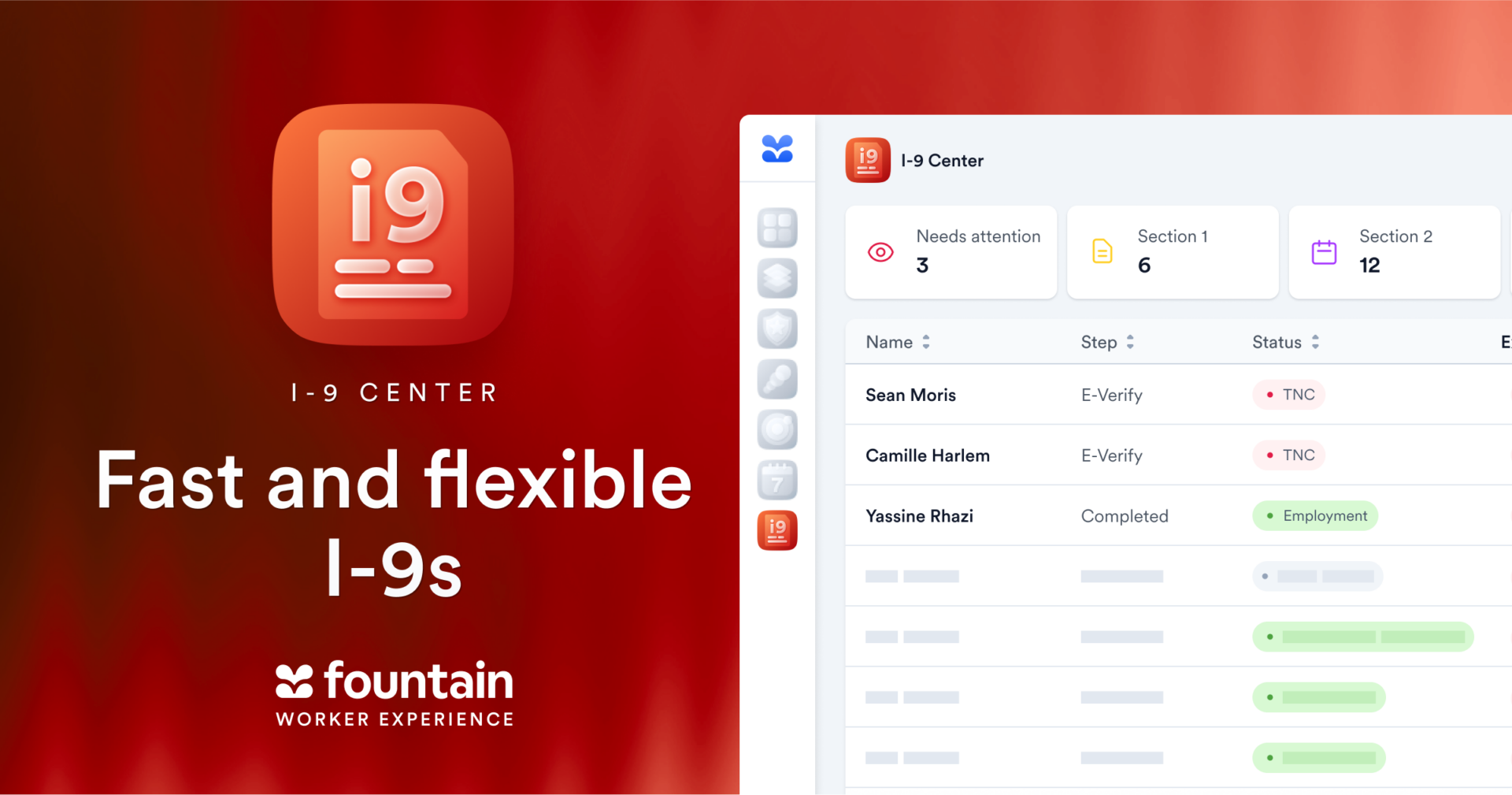
Stay Audit-Ready with Fountain’s I-9 Solution
Tired of manual I-9 processes and compliance risks? Fountain’s I-9 Center automates verification, integrates with E-Verify, and ensures 100% audit-ready records—all in a mobile-first platform designed for frontline hiring. Reduce errors, eliminate paperwork, and stay compliant with ease.
Front of house (FOH)
FOH training centers on the guest-facing skills that drive both service quality and check size. Cover the POS system in depth (entering orders, splitting checks, applying discounts), service standards and greeting scripts, full menu knowledge, and payment and tip handling, including tip reporting and pooling.
Build a FOH checklist with POS certification, a menu quiz, payment handling, tip reporting, and side-work signoff, so the manager sees POS practice completed before a server works a live table.
Back of house (BOH)
BOH training leads with safety and consistency. Start with food-safety protocols (handling, sanitation, temperature and storage standards) and allergen awareness, then move to kitchen equipment operation and cleaning. Station setup and breakdown (mise en place), recipe standards, plating guides, and ticket reading round out the week, and new cooks should taste menu items early to lock in consistency.
Build a BOH station-readiness checklist covering food safety, allergen awareness, equipment cleaning, mise en place, recipe standards, and ticket reading, and verify signoff before assigning solo line work.
Managers
Manager onboarding covers the work that keeps the location running: opening, closing, inventory, scheduling, vendors, and conflict handling. Closing alone includes end-of-day reports, reconciling the register against POS sales, and confirming the next day’s schedule is posted.
Managers also own location-level compliance, so their track should add I-9 timing, tip-credit notices, food-handler requirements, safety training, and local break rules, all documented before a new manager owns a close.
Two practices apply across all three tracks:
- First, assign a mentor or training buddy: a SHRM onboarding guide found 56% of new hires called having a buddy or mentor very important when starting, and Chipotle’s Burrito Buddy program pairs new employees with experienced partners for their first 90 days.
- Second, run a supervised practice shift during lower-volume service so new hires can make mistakes without derailing the rush.
Peak service before someone has practiced the role hurts the guest experience and shakes the new hire’s confidence.
Compliance essentials for restaurant onboarding
Restaurant onboarding must document employment eligibility, tax paperwork, food-handler and safety training, tip-credit notices, and local labor-law requirements before new hires work independently. These are common best practices, not legal advice; confirm with counsel and your local health department.
Configure one location’s compliance flow in Fountain Onboarding, then hold each category to the timing rules that trip teams up most:
- Employment eligibility runs on a strict clock: Section 1 of Form I-9 is due no later than Day 1 of employment, and Section 2 within three business days after work begins. Late or incomplete I-9s create compliance exposure, so assign both deadlines in the workflow.
- Tax paperwork is federal plus state: Form W-4 must be completed before or on Day 1. Some states use the federal W-4, others require a separate state withholding form, and some have no state income tax withholding certificate at all.
- Food-handler and ServSafe rules vary widely by state: Deadlines, certificate rules, and employer-payment obligations differ by jurisdiction, so confirm the local requirement first. The ServSafe Regulatory Requirements Map lists rules by jurisdiction.
- Safety training starts before station work: Under the Occupational Safety and Health Administration (OSHA), Hazard Communication training must occur at initial assignment, and restaurant safety hazards (burns, cuts, slips, equipment) need coverage before anyone works a station.
- Local labor law rounds it out: Under the Fair Labor Standards Act (FLSA), tip-credit notice rules require employers to inform tipped employees in advance; without that notice, an employer generally cannot take the tip credit. Federal rules don’t require meal or rest breaks, but state laws like California’s and Oregon’s do.
One flow keeps managers from discovering missing forms after the employee is already on the schedule.
The 30/60/90-day retention check-in
Use 30-, 60-, and 90-day check-ins to catch training gaps, disengagement, and fit issues before new hires resign. Frontline turnover is heavily front-loaded: many frontline workers leave within the first few months, which is why structured check-ins at these milestones matter.
- 30 days: Evaluate foundational knowledge and comfort. Check attendance, crew fit, and basic role skills, and ask whether they feel trained and equipped, so you surface skill gaps and missing tools before the employee decides to leave.
- 60 days: Shift the focus to independence as shadowing drops and busier shifts get assigned. Watch for disengagement signals like no-shows, late arrivals, or frequent schedule-change requests.
- 90 days: Focus on full integration and ownership. The employee should work independently to the concept’s protocol, and this is the moment to set development goals and discuss cross-training or raise eligibility, whether that’s a server hitting upsell targets, a cook running a station solo, or a manager owning a full close.
Add these check-ins as manager tasks in Fountain Onboarding so skill gaps and support needs get reviewed before the next schedule cycle, not after a resignation.
Common onboarding mistakes, and how to scale past them
Five patterns cause most onboarding failures:
- Paperwork overload buries new hires before they’ve met the team.
- One-size-fits-all training runs a dishwasher and a general manager through the same process.
- Weak cultural integration leaves people feeling like temps.
- No check-in after week one lets them disengage.
- A missing 30/60/90 plan removes the feedback loop that keeps people on track.
These problems compound across locations, where paper checklists make it hard to confirm which forms are complete and which sites need follow-up. Paper also complicates location-specific routing for state tax forms or tip-credit acknowledgments and leaves audit readiness dependent on manual recordkeeping.
A digital workflow moves Day-1 paperwork and location tracking into one place: new hires finish paperwork on mobile before Day 1, a single dashboard tracks completion across every location, and automated reminders chase overdue tasks. Managers still approve offers, verify documents, and handle exceptions; the workflow handles routing and reminders.
How Fountain runs restaurant onboarding
Restaurants lose new hires after the offer but before they become productive, and at multi-location scale the compliance gaps and drop-off pile up faster than managers can track by hand. Fountain runs onboarding through Cue, the orchestration layer connecting hiring and onboarding across every location.
Instead of clicking through a dozen workflows, a manager types one prompt: “Onboard 15 new hires across three locations before the weekend and flag anyone missing I-9 or food-handler docs.”
Cue coordinates Fountain’s agents against that request. Emma, Fountain’s 24/7 support agent, answers candidate questions and gets every form (I-9, W-4, onboarding paperwork) completed before Day 1, while Sam runs post-hire feedback at the milestones where disengagement and scheduling issues tend to surface.
People stay in the loop throughout: the agents route, remind, and propose, and managers approve offers, verify documents, and handle exceptions.
The gap between “hired” and “productive” is where restaurants lose people and pay to rehire. Operations that treat onboarding as a structured, compliant, role-specific process keep more people past 90 days; the ones that treat it as a single orientation shift keep reopening the same reqs.
Ready to close the offer-to-Day-1 gap? Book a demo to see how Cue, Emma, and Fountain Onboarding run FOH, BOH, and manager onboarding across every location.
Frequently asked questions about restaurant onboarding
How long should restaurant employee onboarding take?
Plan for at least 90 days, with onboarding touchpoints extending through the first six months to a year. Structured onboarding across the first three months makes employees 69% more likely to stay for three years. The first two weeks build competence; the 30/60/90 check-ins protect retention through the window when most frontline workers leave.
What paperwork is required for new restaurant hires?
Every new hire needs a completed Form I-9 and Form W-4. I-9 Section 1 is due by Day 1 of work and Section 2 within three business days. Many states also require a separate state tax withholding form, and tipped positions require a tip-credit notice at or before onboarding.
What is the difference between orientation and onboarding?
Orientation is a short-term process covering first-day paperwork and basic introductions. Onboarding is the broader, longer-term process that integrates a new hire into the company culture and gives them the tools to become productive. A single orientation shift can’t build the role competence or cultural connection that keeps people past 90 days.