Every open frontline role runs two clocks at once. One belongs to the candidate, who is deciding whether the form is worth finishing. The other belongs to the manager, who watches the role sit unfilled while screening and scheduling grind forward.
Both clocks bill in real dollars the whole time, in abandoned applicants who must be re-sourced and overtime paid to cover open shifts, and candidates feel the drag first: 57% of frontline candidates cite slow hiring as a top frustration in the 2025 Fountain Frontline Report, Fountain’s survey with Lighthouse Research & Advisory of roughly 2,000 frontline workers.
This guide is written for frontline and hourly hiring managers, including those who don’t control the ATS or the high-volume hiring process end to end. Some of the fixes below sit inside a manager’s own authority today; the rest are evidence-backed requests to send to talent acquisition (TA) or ops.
What are application time costs?
Application time costs are the money lost to time in the application-to-hire window. Every dollar that leaks out between a candidate opening a job application form and a hired worker covering their first shift belongs in that number.
The term sits next to two metrics most hiring teams already track: a cost-per-hire calculation measures what a hire costs, and average time-to-hire measures how long one takes. Application time costs measure what the waiting itself costs, on both clocks at once, as candidates are lost while the application drags and shifts stay uncovered while the funnel grinds.
A location can have an acceptable cost-per-hire and a defensible time-to-hire and still lose money through abandonment, no-shows, and overtime, because those costs do not show up in either metric.
Why application time quietly drives hiring costs
Four mechanisms convert idle days into spend, and each one is measurable:
- Abandonment shrinks the funnel: roughly 60% of applicants abandon job applications that are too long or not mobile-friendly, per Fountain’s Redefining Frontline Operations white paper, and every candidate who quits mid-form has to be replaced with newly sourced traffic.
- Slow stages hand hires away: frontline candidates are often holding more than one live application, so every idle day hands finalists to faster employers. In Talent Board’s candidate experience research, the highest-rated employers moved candidates forward within 3 to 5 days of application.
- Ghosting multiplies rework: silence in the process reads as rejection, and 52% of candidates in the same Frontline Report cite ghosting or a lack of updates. When candidates lose interest and stop responding, shifts stay uncovered and the hiring cycle restarts from zero.
- Unfilled seats bill daily: open shifts become overtime and lost throughput long before a requisition closes. Peer-reviewed research in Production and Operations Management across 41 stores of a retail chain found peak-hour understaffing costs an average 8.56% of sales.
These stack. A candidate who abandons mid-form repeats the sourcing spend, the re-sourced replacement waits in the same slow screening queue, and the seat bills overtime the entire time.
Where application time leaks, stage by stage
Application time leaks before submission and through waiting and sequencing later in the funnel. The first leak is the posting itself: candidates who can’t see the pay often abandon the application, and a posting that hides the wage spends screening time on people who were never going to take it.
Long or desktop-only applications compound the loss. Most frontline candidates apply from a phone, on a break or between shifts, and long, desktop-era forms lose them before submit, especially when the form demands a resume or an account.
The middle and back of the funnel leak through sequencing.
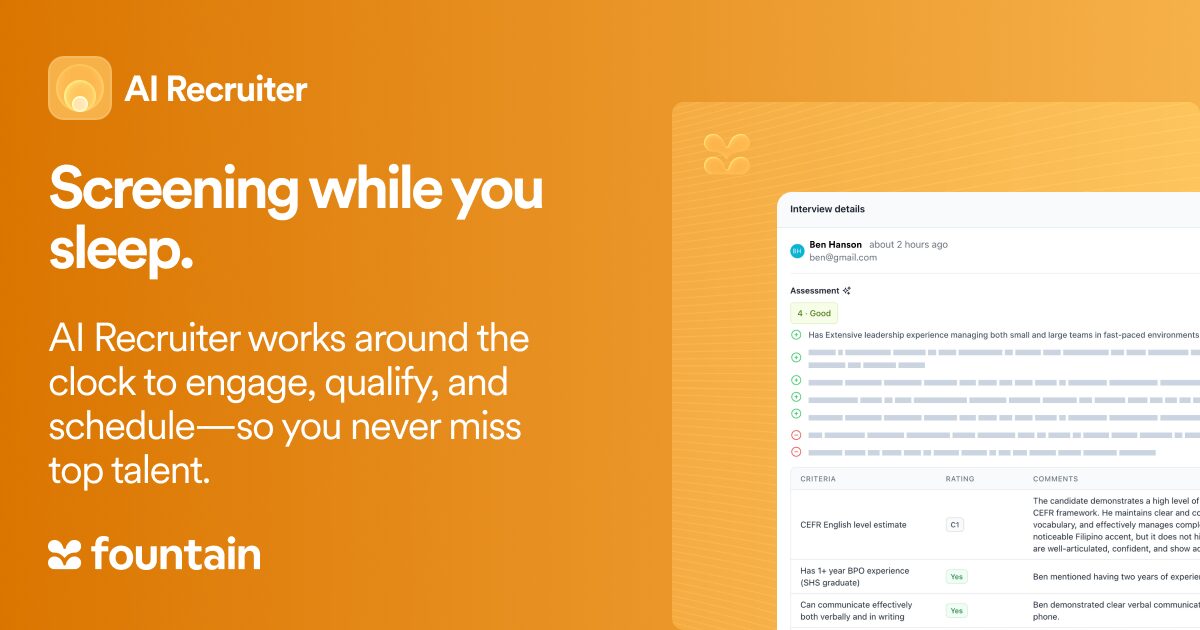
Smarter, faster hiring built for frontline teams—because efficiency is essential, not optional.
Transform your frontline hiring process with Fountain’s Agentic AI—automation that doesn’t just streamline workflows, but drives real business impact.
✅ Cut time-to-hire by 79%
✅ Save $1.2M+ in annual labor and attrition costs
✅ Improve first-year retention by 30%
Download our new white paper or request a personalized demo to see how Agentic AI delivers measurable ROI for high-volume hiring.
A day in the screening queue functionally bills like a day of vacancy, since the shift still needs covering. Interview scheduling ping-pong adds days that a calendar link would erase, and background checks that start only after offer paperwork finishes stretch the offer-to-first-shift gap into the window where a candidate weighing other employers disappears.
Calculate the cost with your own numbers rather than a benchmark. Take your base wage and the uncovered shift-hours in a typical week, then apply the overtime premium: the Fair Labor Standards Act sets overtime pay at 1.5 times base wage for hours past 40 in a workweek, so each covered hour carries a half-wage premium.
Overtime rules vary by state and role, so confirm the math with your HR or legal team.
When existing staff absorb the open shifts, a week of delay costs uncovered hours times half the base wage in premium pay. Using placeholder numbers, $18 an hour and 40 uncovered hours, that’s $360 a week at one site, before any lost sales or agency labor.
Weeks open multiplied by that weekly figure is what the funnel’s idle time costs at that location.
How to cut application time costs when you don’t own the ATS
Managers can cut application time costs through two channels: actions inside their own authority today, and specific requests to bring to TA or ops, worded so the person who owns the system can act on them.
- Rewrite the posting for self-selection: put pay and schedule up front, and state the exact worksite to filter out mismatches before they cost screening time.
- Hold standing interview slots and a same-day decision rule: pre-blocked calendar time removes the longest wait in the funnel, and a rule that anyone interviewed today gets an answer today stops finalists from shopping the silence.
- Start with warm lists: past applicants, boomerang workers, and employee referrals skip the top of the funnel and arrive already familiar with the operation.
- Request a sub-five-minute mobile application: ask for a form that is resume-free and finishable on a phone during a break, and attach the 60% abandonment figure above as the evidence.
- Request automated screening and self-scheduling: knockout questions disqualify unqualified applicants instantly, and candidate-booked interviews collapse the idle days between screen and conversation.
- Request parallel compliance: start background checks and paperwork when the offer is issued to close the offer-to-first-shift gap where accepted candidates vanish.
Agentic screening and scheduling handle the repetitive middle of the funnel while you approve interviews, offers, and exceptions. Your job is to name the leak and ask for the fix.
How to prove the savings and make the case upward
The case upward runs on four location-level funnel numbers translated into money. The metrics to track, or to request from TA if you don’t own the reporting, are location time-to-fill, application completion rate, stage-by-stage conversion, and interview show rate, four of the candidate experience metrics that predict funnel health, each read location by location.
Pull the last 30 days from your ATS reporting and set that baseline before you change anything.
Location-level reading is the part most reports skip. A bottleneck at one site hides inside a healthy mean: a 25-day chain-wide average can contain stores filling in 14 days and stores stuck at 45, and each needs a different fix.
Stage conversion pinpoints which fix, since a location with strong completion and a weak show rate points toward scheduling rather than the posting.
Then turn movement into dollars. Every day cut from time-to-fill at one of your locations is a day of overtime premium avoided, priced by the worked example above. Improve the show rate and fewer interview slots end in a restart.
Filling the seat sooner also restores the throughput and sales an understaffed shift forfeits. Overtime avoided and shifts covered travel further in a budget conversation than candidate experience does, so lead with the dollars and attach the funnel metrics as evidence.
How Fountain reduces application time costs for frontline teams
Fountain attacks both clocks the same way: agents work the waiting, and managers keep the decisions. The platform is purpose-built for high-volume hourly hiring, most of it done from phones, and Cue is the orchestration layer and single AI entry point across it.
A manager types a plain-language goal, “Get our average time-to-apply under five minutes and fill the 12 open roles at our highest-priority site by Friday,” and Cue coordinates the agents and workflows underneath, routing approval requests back to the manager.
Each agent covers one of the leaks above:
- Screening: Anna, the AI Recruiter, runs voice screens around the clock, scores candidates against your predefined qualifications, and passes qualified applicants to you.
- Scheduling: the ATS runs a mobile-first application with knockout screening, bi-directional calendar sync lets candidates book their own interviews, and Emma, AI 24/7 Support, answers candidate questions at any hour so no one stalls waiting for a human reply.
- Onboarding: Fountain Onboarding starts I-9 and E-Verify at offer and triggers background-check partners in parallel through Fountain’s integrations, closing the offer-to-first-shift gap where accepted candidates vanish.
Managers approve every interview and offer, including exceptions; between approvals, the agents keep the funnel moving, and Sam, AI Satisfaction, keeps listening after Day 1 so a fast hire doesn’t become a week-two quit.
The pattern shows up with Alto’s use of Fountain: the luxury rideshare operator hired 450 drivers in 6 months with a team of 3 recruiters, at a $300 average cost-per-hire against SHRM’s roughly $4,700 benchmark, with a 2- to 7-day time-to-offer.
The same changes shorten both clocks. The candidate’s clock drops when the application takes minutes and the screen happens the same day; the manager’s clock drops when compliance runs alongside scheduling instead of after it. To test that on your own funnel, bring the time-to-fill and completion figures from your slowest location to TA with one ask: a pilot of AI screening at that site while the others keep their current process.
See the before-and-after on a live workflow: book a demo to walk through mobile apply, self-scheduling, and offer-time onboarding against your own numbers.
Frequently asked questions about application time costs
What are application time costs?
Application time costs are the money lost to time between a candidate opening a job application and a hired worker covering their first shift. They show up as re-sourcing spend for abandoned applicants and as the operational bill for uncovered shifts, both overtime pay and sales lost to understaffing while the role stays open.
How is application time different from time-to-hire?
Time-to-hire tracks how many days one candidate takes from entering the process to accepting an offer. Application time costs price the entire window in dollars, including candidates lost during a slow application and the operational cost of an empty seat.
Can AI reduce application time without removing human review?
Yes. Anna handles screening between application and interview, Fountain’s ATS supports candidate self-scheduling, and Fountain Onboarding processes related paperwork. Humans approve final hiring decisions, including offers and exceptions.