Artificial narrow intelligence (ANI) is the only kind of AI that exists in production today. Artificial general intelligence (AGI), which would match human reasoning across domains, and artificial superintelligence (ASI), which would exceed it, are research goals rather than shipping software.
Most current systems are still classified as narrow AI in peer-reviewed literature, including the ones with “superintelligence” in the brand name. The vocabulary is blurring fast, and vendors now use all three terms in the same product demo. Frontline workers are already choosing the AI that exists: 74% prefer AI voice interviews to waiting for a scheduled call, per the 2025 Fountain Frontline Report.
This guide pins down the three tiers and what the labels mean for AI buyers.
What is narrow AI vs general AI vs superintelligence?
Narrow AI is built to perform one bounded task or a narrow set of tasks; it cannot reason or learn beyond its programmed scope. General AI is a theoretical system that could perform any intellectual task a human can, adapting across domains without task-specific retraining.
Superintelligence is a hypothetical system whose capabilities would exceed the best human performance in essentially every domain.
Narrow AI: the only kind that exists
Narrow AI is task-specific by design. Netflix’s AI recommendation system predicts what to watch next, and Siri matches spoken requests to programmed responses, and neither can pick up the other’s job: competence learned in one domain doesn’t carry into another.
The same pattern runs through the hiring stack. AI resume screening flags, scores, or routes applicants against criteria a team defines, with recruiters keeping final decision authority, and conversational AI conducts structured screening and scores the responses. Each is narrow AI doing a bounded job well, and each fails outside that boundary.
Generative AI complicates the picture without changing it. Large language models, the systems behind tools like ChatGPT, feel general because they can discuss almost any topic.
Breadth of topics is not breadth of reasoning: ChatGPT performs specific generation tasks, and a model that has read about a subject can produce fluent output without understanding it, which is where confident AI errors in hiring and operations come from.
General AI: the human-level frontier
AGI would handle an unfamiliar problem the way a capable person does, by transferring what it learned elsewhere. A single AGI could, in principle, handle candidate screening one hour and shift-coverage planning the next without being rebuilt for each task.
We have no current AGI, and researchers haven’t settled on an accepted definition of what would count as one. The path is just as contested: scaling larger and multimodal models is one route, and architectures built around world models are another.
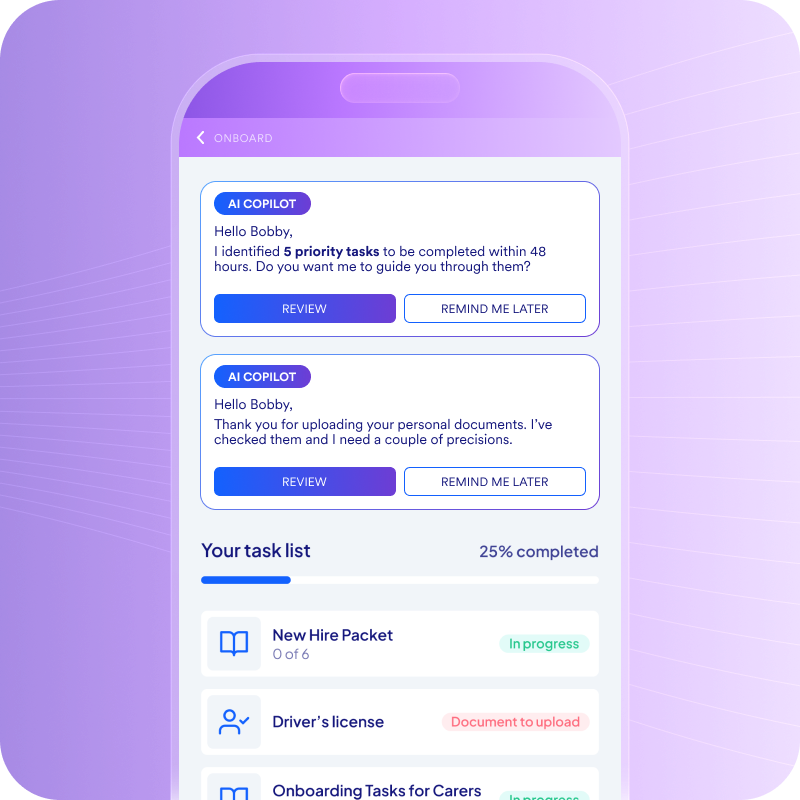
Faster ramp-up. Lower early attrition. AI onboarding built for speed, scale, and retention.
Top employers are already using Fountain’s Frontline OS to:
✅ Reduce turnover in the first 60 days
✅ Eliminate manual paperwork and task delays
✅ Accelerate new hire productivity with smarter workflows
Curious what smarter onboarding could unlock for your team?
When the people building the technology disagree on both the destination and the road, any vendor claiming to have arrived deserves skepticism.
Artificial superintelligence: beyond human capability
ASI sits one hypothetical tier past AGI. Nick Bostrom’s 2014 book Superintelligence: Paths, Dangers, Strategies defines it as “any intellect that greatly exceeds the cognitive performance of humans in virtually all domains of interest.” The category remains a theoretical concept, and everything written about ASI, including the risk debate below, is a projection about a system that does not exist.
Narrow AI vs general AI vs superintelligence: side-by-side
The tiers separate on scope, learning, autonomy, and existence status.
| Dimension | Narrow AI (ANI) | General AI (AGI) | Superintelligence (ASI) |
| Scope | One bounded task or domain | Any intellectual task a human can do | Beyond the best humans in essentially every domain |
| Learning and generalization | Learns patterns within its training domain; skill doesn’t carry across domains | Would transfer learning to new tasks and contexts without retraining | Would surpass human reasoning, creativity, and strategy |
| Autonomy and oversight | Acts within rules and permissions operators define; needs human review at decision points | Would self-direct across domains (hypothetical) | Would exceed direct human supervision (hypothetical) |
| Existence status | In production today | Theoretical; active research goal | Hypothetical; a projection past AGI |
| Examples | ChatGPT, Siri, recommendation engines, resume screening, voice screening, demand forecasting | None | None |
A second taxonomy from researcher Arend Hintze sorts AI into four functional types:
- Reactive machines
- Limited memory
- Theory of mind
- Self-aware AI
The first two exist and are narrow AI; the last two remain theoretical, near the AGI and ASI tiers.
How close are AGI and superintelligence?
Forecasts disagree by decades, and the disagreement is the point. The largest researcher survey to date, 2,778 published AI researchers, put a 50% chance of high-level machine intelligence by 2047. The same respondents put a 50% chance of full automation of all human labor at 2116; different questions produce different dates.
Lab leaders run far shorter. Anthropic CEO Dario Amodei warned in January 2026 that superhuman AI could arrive as soon as 2027, and Google DeepMind CEO Demis Hassabis said in July 2026 that AGI is probably a few short years away. Use short timelines to pressure-test your AI approval and review processes, not as proof that current products are AGI.
Contracts signed this year will run their full term on narrow AI under even the most aggressive lab timeline.
The real risks, near and far
The risks worth budgeting for now come from deployed narrow AI:
- Bias enters through training data and multiplies through volume. Amazon scrapped an internal recruiting model in 2018 after it taught itself to penalize resumes containing the word “women’s,” learned from a decade of male-dominated hiring data.
- Liability stays with the employer, not the tool. After Air Canada’s chatbot gave a passenger wrong bereavement-fare information, the airline argued the bot was “a separate legal entity responsible for its own actions.” A British Columbia tribunal rejected that argument in February 2024. Employers deploying candidate-facing AI own its outputs.
- Jobs get redesigned more often than replaced. The World Economic Forum’s Future of Jobs Report 2025 projects 170 million new roles and 92 million displaced by 2030, while 40% of employers expect to cut headcount where AI automates tasks. An NBER study of 5,000+ customer support agents found AI assistance raised productivity 14% on average, with the biggest gains for less-experienced workers.
The long-term debate is louder but less actionable. Geoffrey Hinton left Google in 2023 to speak freely about AI risks; Yann LeCun calls existential worries “complete B.S.” Neither camp claims today’s systems are anything other than narrow, so keep it separate from the controls deployed hiring AI needs.
Regulators already treat hiring AI as high-risk, whatever vendors call it.
The EU AI Act’s employment rules apply from December 2, 2027; New York City has required bias audits and candidate notice for automated hiring tools under Local Law 144 since 2023; and California and other state rules follow through 2027.
Before signing a multi-year contract, ask for audit trails, candidate notice workflows, and human-review controls, and confirm specifics with counsel.
What vendors mean when they say “superintelligence”
“Superintelligence” now shows up in enterprise software marketing years before anyone has built one. As of March 2026, Workday markets Sana, its “superintelligence for work”. Meta describes “personal superintelligence” as a goal, in the future tense, through a research division formed in June 2025. Frontier labs use the word for a research target.
None of them claims ASI exists; the label names agentic software or an ambition, so read it as positioning rather than capability.
Fountain defines its category the same way. Frontline Superintelligence is intelligence that runs work, not software that reports on it: agentic systems that execute bounded frontline workflows (screening, scheduling, onboarding, compliance checks) inside operator-set permissions, with sensitive steps routed to a human for approval.
The breakthrough is not a bigger model but the loop between knowing and doing; model size alone does not fill an open Friday shift. Nor does the label mean removing humans: managers keep decision authority while the system escalates edge cases instead of guessing.
The useful buyer question is not which tier a product belongs to, but where your team still translates insight into action by hand, the line that separates automation from superintelligence in a hiring stack. Ask which workflow the product completes, what permissions it uses, and where a manager approves the result.
Agentic systems move work from a dashboard prompt to a completed task, the same test that separates an agentic ATS from a traditional one.
How Fountain puts Frontline Superintelligence to work
Frontline operations feel these tiers in coverage, not vocabulary: when screening stalls or onboarding paperwork sits in a queue, the cost is an uncovered route or an understaffed dinner rush. Cue, the orchestration layer above every Fountain agent and product, closes that gap.
A regional operator can prompt Cue with “We’re launching in Ventura, California, and need a staffing plan,” and Cue turns Fountain data and agents into a draft hiring plan, sourcing campaigns, onboarding steps, and shift schedule the team reviews in minutes.
Cue coordinates three live agents:
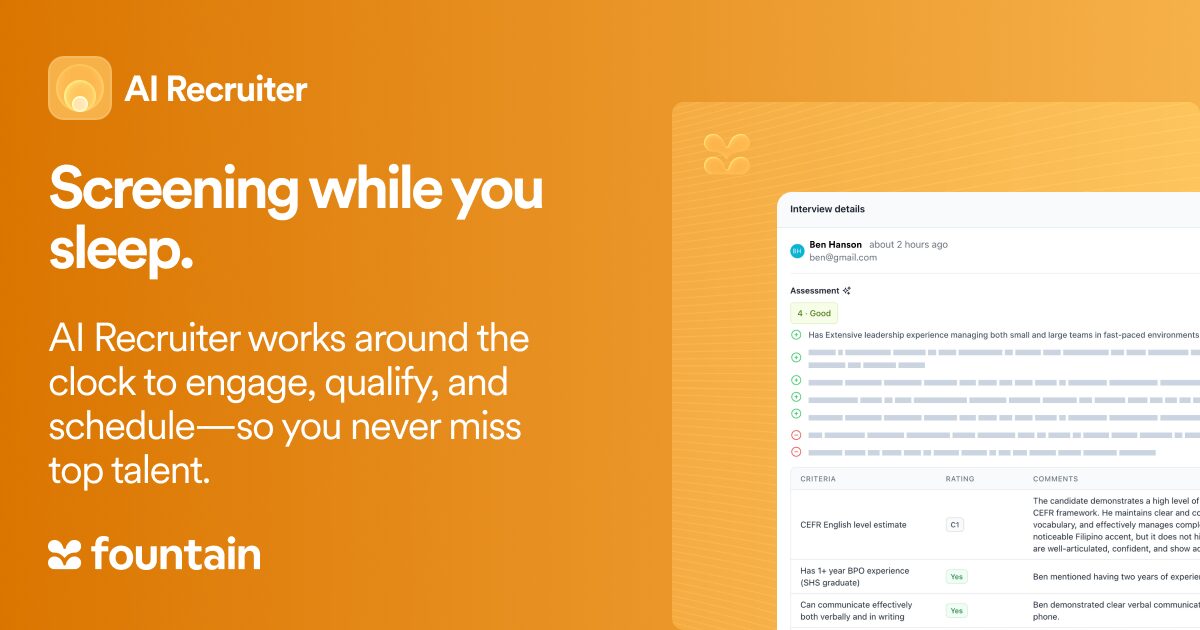
- Anna, the AI Recruiter, conducts voice screening interviews around the clock and pushes scored, qualified candidates to recruiters.
- Emma, AI 24/7 Support, answers candidate and paperwork questions at every stage before they stall a start date.
- Sam, AI Satisfaction, checks in after the start date and flags retention risk early. Managers approve every offer and exception.
The agents act on Fountain’s core products, ATS, Sourcing, CRM, Onboarding, and Shift & Scheduling, one operating layer for AI workforce management across every location. With Fountain, Fetch cut time-to-hire from 15 days to 6.5 hours with Anna in its driver hiring flow, turning screening speed into route coverage.
The three terms in this article’s title will keep blurring in sales decks, but the tiers haven’t moved: narrow AI exists, AGI and ASI don’t, and the practical difference between products is how much bounded work they complete without a human pushing every step.
See the working tier live: book a demo to watch Cue turn a plain-English staffing goal into agent tasks, Anna screen a candidate by voice, and a manager approve the result.
Frequently asked questions about narrow AI, AGI, and ASI
Is ChatGPT narrow AI or general AI?
ChatGPT is narrow AI. It performs specific generation tasks, and covering many topics in conversation is not the same as reasoning across domains like a person.
Does artificial general intelligence exist yet?
No. AGI remains theoretical, and experts disagree on both its definition and its timing: the largest researcher survey puts a 50% chance of high-level machine intelligence around 2047, while some lab leaders forecast this decade. Evaluate today’s products as narrow AI and contract for governance rather than promised capability.
Why do software vendors use the word “superintelligence”?
Vendors use it as brand language for agentic AI products or as a label for research ambitions; none claims ASI exists. The practical response is to ask what workflow the product completes and where a manager approves the result.