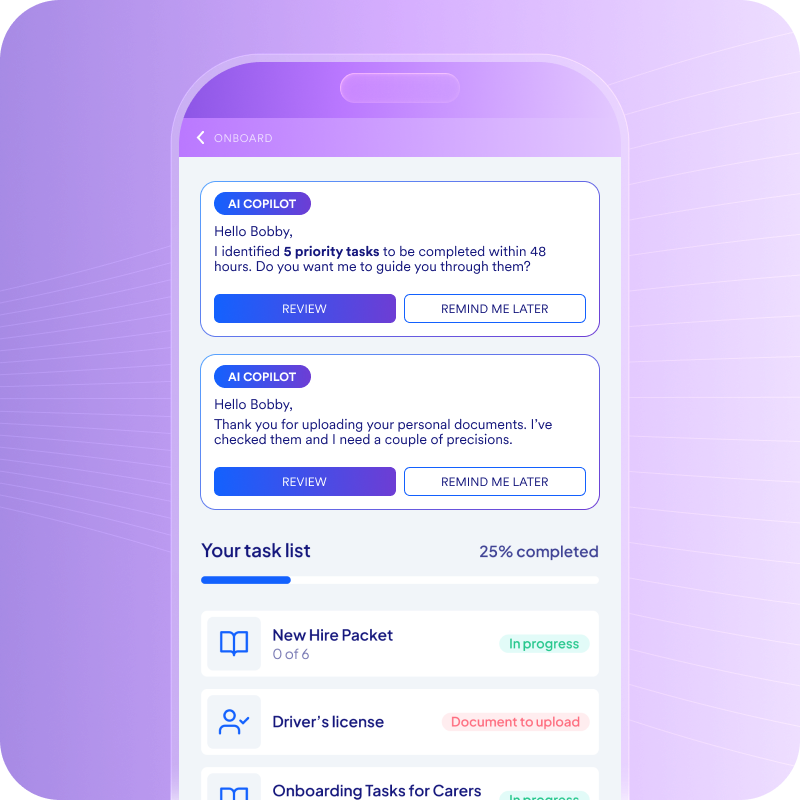
High-volume frontline hiring breaks most recruiting tools. When an employer is filling 500 roles across 200 locations and candidates take the first offer that arrives, the gap between “application received” and “first shift worked” determines whether locations stay staffed or operations stall.
According to Fountain’s Redefining Frontline Operations report, 60% of applicants abandon applications that feel too long or aren’t optimized for mobile, and 42% withdraw if scheduling drags. The 2025 Fountain Frontline Report adds the sharper edge: 57% of frontline candidates cite slow process as their top frustration, and 52% cite ghosting.
Fountain and Paradox AI both target this problem. Buyers compare them because both appear in frontline hiring evaluations, both handle candidate screening and scheduling, and both serve quick-service restaurants (QSR), retail, logistics, and healthcare employers. Software is moving to the back end, agents are moving to the front, and the deciding question for any high-volume hiring strategy in 2026 is whose agents actually run the work.
What’s the difference between Fountain and Paradox AI?
Fountain is an agentic operating system for frontline hiring and workforce operations. Cue sits above 3 named agents and orchestrates the worker lifecycle from sourcing through scheduling, all on a single platform.
Paradox AI, on the other hand, is a conversational AI layer that automates screening and interview scheduling, primarily through its chatbot Olivia, now running as the Workday Paradox Candidate Experience Agent following its October 2025 acquisition.
Fountain replaces the frontline applicant tracking system (ATS) and runs the lifecycle end to end. Paradox adds a conversational engagement layer to an existing ATS, with Workday as the native back end.
The orchestration gap is the bottom line. Paradox ships one conversational agent; Fountain ships an orchestration layer that coordinates work across multiple agents and products. One agent automates a workflow; an orchestration layer runs the operation.
The distinction matters because frontline hiring doesn’t stop at the scheduling handoff: it runs through onboarding, I-9 and E-Verify, the first shift, the first 30 days of retention risk, and the next seasonal peak.
How we evaluated both platforms
Comparison articles age fast in 2026 because agentic AI is the variable doing most of the work. We evaluated both platforms against the criteria buyers are asking about on calls.
- Agent depth and orchestration: Named agents, what they do, and whether a copilot orchestrates across products or each agent stops at the one it’s bolted into.
- Workflow coverage: Whether the platform handles the full lifecycle from sourcing through scheduling and retention, or only a slice of it.
- Compliance posture: I-9 and E-Verify support, remote authorized representative workflows, audit-ready document storage.
- Integration flexibility: Native human resources information system (HRIS) and human capital management (HCM) connectors, willingness to operate alongside existing stacks rather than replace them.
A tool that wins on agents but stalls on workflow coverage is a different recommendation than one that ships every product but lags on agent depth.
Paradox AI at a glance
Paradox built its reputation on Olivia, a conversational AI assistant that automates candidate chat, Q&A, and interview scheduling through text-based conversations across SMS, WhatsApp, WeChat, and Facebook Messenger. In October 2025, Workday completed its acquisition of Paradox, and Paradox’s conversational recruiting product became available through Workday in January 2026.
Paradox has named QSR deployments including McDonald’s, Chipotle, Compass Group, CVS Health, and FedEx. McDonald’s reported a 65% drop in time-to-hire with McHire, powered by Olivia.
Outside its screening-to-scheduling core, Paradox depends on integrated systems for sourcing, onboarding, shift management, compliance, engagement, and analytics. Workday handles those for Workday customers; non-Workday customers wire in separate tools.
Feature comparison between Fountain and Paradox AI
| Capability | Fountain | Paradox AI |
| Full ATS with configurable workflows | Yes, designed for frontline | Conversational layer; requires existing ATS for non-Workday customers |
| Named agents and orchestration | Copilot + voice screening + 24/7 candidate support + post-hire engagement | Single conversational agent (Olivia), text-led |
| AI screening method | Voice interviews with scoring and human-in-the-loop handoff | Text-based chat screening |
| Native sourcing | Multi-channel with agentic optimization | None; requires separate platform |
| Onboarding with I-9 and compliance | Native, with E-Verify and remote authorized rep | Through Workday or separate HRIS |
| Shift & Scheduling | Native, with AI-driven demand forecasting | None native |
| Post-hire engagement agent | Yes | Not documented |
| HRIS integration | UKG, SAP, ADP, Workday | Workday native; others vary |
1. Candidate application experience
Both platforms prioritize mobile. Fountain emphasizes mobile-first applications without account creation, with 85% of candidates applying via mobile, and the ATS carries the candidate through every subsequent step: offer signed by phone, onboarding completed by phone, I-9 by phone, first-shift scheduling by phone.
Paradox adds a chat-based conversation layer to the application process, with Olivia handling screening, common questions, and scheduling through text, then relying on integrated systems for downstream steps.
2. AI screening and orchestration
Fountain runs voice-led AI screening underneath an orchestration layer that coordinates work across multiple agents and products. The screening agent conducts real voice interviews and scores candidates against role-specific criteria, with qualified applicants pushed to the hiring team for final decisions.
At Fetch, a package delivery platform, AI voice screening cut time-to-hire by 95% (from 15 days to 6.5 hours) and lifted hire rate by 125%. Per Fountain platform data, 74% of applicants choose AI voice screening over waiting for a scheduled call.
Paradox runs text-based screening through Olivia, asking qualification questions and routing candidates through automated workflows. As a single conversational agent rather than one in an orchestration layer, Olivia doesn’t coordinate work across other named agents because there aren’t any to coordinate.
3. Post-hire onboarding, compliance, and engagement
This is the widest gap between the two platforms. Fountain offers native Onboarding with I-9 completion, E-Verify integration, remote authorized representative support, and compliance tracking. At UPS, Fountain’s Onboarding workflows drove 98% I-9 completion by Day 1, up from roughly 50% with a prior vendor. GoFor cut time-to-onboard by 83% (30 days to 5 days) and reduced applicant attrition by 62%.
Fountain also runs a post-hire engagement layer that handles milestone touchpoints at Day 1, 10, 30, and 60, capturing sentiment and flagging retention risk while there’s still time to intervene.
Paradox’s post-hire capabilities are limited as a standalone product. Onboarding, compliance, and scheduling depend on integration with the employer’s existing HRIS, with Workday as the native back end. Paradox does not ship a comparable post-hire engagement agent.
4. Sourcing
Paradox is not classified as a sourcing tool by independent reviewers; building a top-of-funnel pipeline requires a separate platform. Fountain Sourcing runs AI-powered multi-channel campaigns across job boards, SMS, and paid channels with predictive shortfall detection and budget optimization tuned against actual hire outcomes.
5. Analytics, reporting, and integrations
Fountain ships embedded analytics across every product, with access through dashboards, direct warehouse connections, or scheduled reports. Fountain integrates with UKG, SAP, ADP, and Workday through webhook, iFrame, and API, working alongside existing HCM stacks rather than replacing them.
Paradox’s analytics depth is limited in cited sources outside the Workday ecosystem. Workday integration is now native; for other HRIS systems, integration availability varies, and post-acquisition roadmap priorities tend to favor the acquiring platform’s customer base.
The capability picture is one half of the decision. The reader profiles below land the other half.
Who should choose Fountain?
The shorthand: choose Fountain if you need an agentic operating system that runs the worker lifecycle, not a conversational layer that automates one slice of it.
- If you hire across dozens or hundreds of locations with different workflows: Fountain supports location-specific funnels, compliance, and onboarding within a single platform. Marsden Services cut a client’s vacancy rate from 18% to 6% and reduced time-to-hire from 18 days to 7.
- If you want one platform from application to first shift, not a stack of point solutions: Fountain covers sourcing, ATS, onboarding, compliance, and scheduling on a single platform. BELAY replaced 4 separate systems and grew monthly hires from 40 to 107 without adding recruiters.
- If your recruiters are buried in manual work at high volume: Fountain’s agents and automation reduce administrative load without removing humans from the hiring decision. Liveops processes 400,000 applications a year with 9 recruiters at a 100% fill rate, and Centerfield cut manual recruiter actions at the top of the funnel by 80%.
- If compliance is a material risk for your organization: Fountain Onboarding includes I-9 with remote authorized representative support, E-Verify integration, automated compliance notifications, and audit-ready storage. The difference between 50% and 90%+ I-9 completion by Day 1 represents significant regulatory exposure for employers hiring thousands annually.
- If you need to keep workers past Day 30, not just get them in the door: Fountain runs milestone touchpoints at Day 1, 10, 30, and 60 through its post-hire engagement layer, flagging retention risk while it’s still actionable.
If 3 or more of these line up with your hiring operation, Fountain runs the work Paradox hands off.
Who should choose Paradox AI?
The shorthand: Paradox fits if you’re on Workday, your bottleneck is the screening-to-scheduling handoff, and the rest of your stack is working.
- If you’re already on Workday and want to add conversational AI without a platform migration: The Workday Paradox Candidate Experience Agent is now native. Chipotle aimed to hire 20,000 employees in roughly 2 months and reduced time-to-fill by 75% within the Workday ecosystem.
- If your hiring process breaks at the screening-to-interview handoff and your other systems work: Flynn Group automated 90% of its hiring process and saved 900,000 hours annually by adding Paradox to its workflow.
- If you’re a large QSR or hospitality employer running on Workday infrastructure: Paradox has named deployments including Compass Group, where its conversational AI supports roughly 160,000 hires per year.
- If you value text-based candidate engagement and don’t need voice screening: Olivia’s text channels are well-suited for candidates who prefer chat over phone.
If your situation is mostly the inverse of the Fountain conditions above, Paradox can fit. If you’re solving for more than the screening-to-scheduling slice, the gap widens fast.
How Fountain runs frontline hiring end to end
Frontline hiring stops looking like a series of handoffs when the platform runs the worker lifecycle as one workflow rather than five disconnected tools, which is what separates Fountain from a conversational layer bolted onto an existing ATS. This is Fountain’s Frontline Superintelligence stack: an orchestration layer, three named agents, and the core products they operate on.
Together, they make full-lifecycle coverage a property of the platform, not a stack-it-yourself problem.
Cue is the layer above Fountain’s agents. A regional TA lead can move work across the platform in plain English: “Hire 50 drivers across our top 10 markets by Monday, prioritize rehire-eligible candidates,” or “Show me every location where time-to-fill is more than 7 days and reallocate sourcing budget.” Every action Cue takes is logged, creating an audit trail teams can review.
Three agents run under Cue:
- Emma handles 24/7 candidate support across SMS, WhatsApp, and web widget, clearing paperwork blockers without a recruiter in the loop.
- Anna conducts voice interviews 24/7 with consistent scoring criteria, while human reviewers keep the final advancement decision.
- Sam takes the pulse of the workforce post-hire and surfaces retention signals at Day 1, 10, 30, and 60, when 43% of new hires leave per the 2025 Fountain Frontline Report.
The agents operate on Fountain’s ATS, Onboarding, and CRM, with Sourcing and Shift & Scheduling rounding out the platform. Onboarding ships native I-9 completion, E-Verify integration, remote authorized representative support, and audit-ready storage; CRM holds a unified talent profile that turns past applicants into future hires.
Bojangles, a QSR chain with 750 locations across the Southeast, cut time-to-hire by 80% (30 days to 5.8 days) and reduced job board spending by 86%, and Stitch Fix lifted day-one show rate from 68% to 95% across warehouse hiring.
The comparison in this guide closes the gap between “we automated screening” and “we run the worker lifecycle.” Paradox automates the screening-to-scheduling handoff inside the Workday ecosystem. Fountain runs the loop end to end with an agentic execution layer built for frontline operations.
See it on a live workflow. Book a demo to walk through a Cue prompt, an Anna voice screening, and a Sam-driven Day 30 retention check from a single platform.
Frequently asked questions about Fountain and Paradox AI
What is the main difference between Fountain and Paradox AI?
Fountain is an agentic operating system for frontline hiring that covers sourcing, applicant tracking, onboarding, compliance, scheduling, and post-hire engagement on a single platform. Paradox AI is a conversational AI layer focused on automating candidate screening and interview scheduling, now operating as part of the Workday ecosystem. Fountain replaces the frontline ATS. Paradox adds a conversational engagement layer to an existing one.
Can Paradox AI work without Workday?
Paradox has historically integrated with other HRIS platforms, but post-acquisition product roadmaps tend to prioritize the acquiring platform’s customer base. Non-Workday customers should verify current integration support and forward roadmap commitments directly with the vendor.
Does Paradox AI handle post-hire workflows like onboarding and retention?
Paradox’s post-hire capabilities are limited as a standalone product, with onboarding, compliance, and scheduling routed through the employer’s HRIS (Workday for native customers, separate tools otherwise). Fountain ships native Onboarding, Shift & Scheduling, and a post-hire engagement agent that runs milestone touchpoints during the first 90 days, when 43% of new hires leave per the 2025 Fountain Frontline Report.