Frontline hiring teams juggling hundreds or thousands of open reqs know the math doesn’t work. Not enough recruiters exist to screen, schedule, and follow up with every applicant manually, and candidates won’t wait while the backlog clears.
Agentic AI changes the equation. Unlike a chatbot answering FAQs, agentic AI refers to systems that execute multi-step tasks toward a goal your team defines: screening, scheduling, following up, and re-engaging past applicants, all around the clock. Recruiters focus on judgment calls and candidate relationships. The system handles everything else.
For operations running hundreds or thousands of open requisitions, faster hires, more recruiter capacity, and staffing that actually keeps pace with demand follow.
This article breaks down:
- What that looks like in practice
- How it works across the hiring lifecycle
- What early adopters are seeing
- How to evaluate platforms built for frontline hiring at scale
Why frontline hiring needs a different approach
Replacing a single frontline worker costs between $6,500 and $7,000, roughly 40% of their annual pay. For a workforce of 10,000, with annual turnover averages 45% according to Fountain’s Agentic AI research, rehiring and lost productivity add up to $40 million a year. In retail, turnover runs even higher at 60% annually, per the 2025 Fountain Frontline Report.
Meanwhile, hiring isn’t getting faster. The average time from application to offer is 27.5 days in the U.S., according to Fountain’s Redefining Frontline Operations white paper. Frontline candidates don’t wait that long.
In Fountain’s 2025 Frontline Report, 57% of candidates cite slow hiring as their top frustration, and 52% say ghosting or lack of updates drives them away. When candidates need to start earning this week, a four-week hiring timeline is a dealbreaker.
The tools most teams rely on weren’t built for this reality. Traditional applicant tracking systems were designed around corporate recruiting, where recruiters manage fewer open roles, and candidates expect a multi-week process.
That model breaks when you need to fill 500 roles across 200 locations, and candidates are applying from their phones between shifts.
What is agentic AI in frontline hiring?
Agentic AI refers to AI systems that execute configured actions toward a defined goal, rather than waiting for human input at every step. In frontline hiring, this means AI that screens candidates, schedules interviews, sends follow-ups, triggers onboarding workflows, and re-engages past applicants, all based on rules and context your team defines.
Recruiters retain control over candidate progression and final hiring decisions. The AI handles the repetitive, high-volume execution.
The distinction from simpler tools matters. AI agents are software entities designed to perceive, decide, act, and achieve goals independently. On the other hand, AI assistants depend on human input and don’t operate on their own.
For frontline recruiting, this distinction matters because of volume. Recruiters in high-volume environments face massive applicant pools, tight deadlines, and candidate drop-off risk at every stage.
For example, Liveops, a virtual contact center, operated at a 44,000-to-1 applicant-to-recruiter ratio with nine recruiters processing 400,000 applications a year. That kind of ratio only works when the system handles repetitive tasks at scale, freeing recruiters for the decisions that need the human touch.
How agentic AI works across the hiring lifecycle
An agentic system operates in a continuous cycle: it reads candidate and workflow data, identifies the next action, executes it, and then uses the result to determine the next step. Here’s what that looks like at each stage of frontline hiring.
1. Sourcing and first contact
Agentic AI builds sourcing plans, distributes job postings across boards and SMS channels, and initiates outreach to candidates matching role criteria.
Instead of a recruiter manually posting to three job boards and checking back later, the system tracks which channels produce actual hires and shifts spend toward the best-performing sources. In sectors with persistent staffing pressure, faster sourcing directly protects hiring capacity.
2. Screening
Agentic screening goes beyond static knockout questions. The system parses applications, tags qualifications against role-specific criteria, and surfaces candidates based on fit, availability, and location. As hiring goals shift, the criteria adapt. Recruiters set the parameters, and the AI applies them consistently across thousands of applicants without the delays or inconsistency that manual review creates. Recruiters then review the surfaced candidates and decide who moves forward.
For context on what this looks like in practice, Centerfield automated their high-volume pipeline and saw an 80% decrease in manual recruiter actions and 88% fewer resumes to screen. That freed their team to focus on evaluating the candidates who actually qualified.
3. Scheduling and reminders
Interview logistics remain a common bottleneck for recruiting teams. An agentic system checks interviewer availability, books the slot, sends a confirmation via SMS, follows up the day before, and reschedules if the candidate doesn’t respond. No recruiter has to manage the calendar manually.
4. Engagement
Continuous nudges via SMS, WhatsApp, and email keep candidates warm between stages. Per Fountain’s Redefining Frontline Operations white paper, 60% of applicants abandon applications that feel too long or aren’t mobile-optimized.
In frontline hiring, delays between stages create room for drop-off and competing offers. Agentic engagement closes that gap by responding within minutes rather than days.
5. Post-hire re-engagement
Past applicants and former workers are a valuable talent pool most teams underuse. Agentic systems match past hires to new openings based on skills, location, and availability, then trigger outreach campaigns without a recruiter initiating each one.
For industries running 45% or higher annual turnover, the existing talent pool is enormous. Re-engaging someone you’ve already vetted is far cheaper than finding someone new.
What the numbers look like in practice
The common thread across companies running agentic and advanced automation workflows is the same: speed goes up, recruiter workload goes down, and hiring keeps pace with demand instead of trailing behind it.
Fetch, a package delivery company, reduced time-to-hire by 95%, from 15 days to 6.5 hours, using Fountain’s AI capabilities. Applicant volume increased 325%, and the hire rate jumped 125%. Nick Prijic, Director of Driver Operations, described it as going “from a horse and buggy to a Formula 1 racecar in a month’s time.”
Another case is Bojangles, managing hiring across 750 locations. They were able to cut time-to-hire by 80%, from 30 days to 5.8 days, using Fountain’s ATS with automated screening and messaging. Job board spending dropped 86%, and automated messaging saved 230 recruiting hours in a single year.
Additionally, Liveops hit a 100% fill rate (up from 90%) and maintained a 44,000-to-1 applicant-to-recruiter ratio with a nine-person team. As Cheryl Gunn, SVP of Operations, put it: “What really stands out about Fountain is the automation and the rules. It seems like such a little thing for an ATS to have, but for us, it was game changing.”
In each case, the operational impact was direct: fewer unfilled shifts, lower overtime, and less revenue lost to understaffing.
Compliance requirements for AI in hiring
Speed matters, but so does legal exposure. SHRM cautions that using AI in hiring and other employment decisions carries especially high risk under federal anti-discrimination laws. State and international rules are now layering on concrete deadlines:
- Illinois (HB 3773): Effective January 1, 2026. Employers must notify applicants and employees when AI is used in employment decisions and must not use AI in ways that directly or indirectly discriminate against protected classes.
- Colorado (SB 24‑205): Effective June 30, 2026. Deployers of high‑risk AI systems must implement documented risk‑management programs, perform impact assessments, and provide clear consumer notices about AI use.
- EU AI Act: AI used for HR, hiring, and worker management is classified as high‑risk under Annex III. Core high‑risk obligations are scheduled to apply from August 2, 2026, with a proposed backstop date of December 2, 2027.
Any agentic system you deploy should be built to withstand regulatory scrutiny. This means detailed audit trails for every AI‑influenced decision, bias testing across protected groups, human override at consequential decision points, and explainability that regulators and auditors can actually review.
If your platform can’t deliver those, the speed gains are unlikely to outweigh the compliance risk.
What to look for in an agentic hiring platform
Not every vendor claiming “agentic” capabilities has built them. Many have rebranded existing chatbots or rule-based automation without changing the underlying architecture. These five criteria separate real capability from marketing:
- Full lifecycle coverage: Does it handle sourcing, applicant tracking, onboarding, compliance, scheduling, and re-engagement? Or does it stop at the offer letter? Systems that cover the full worker lifecycle eliminate the handoff gaps where candidates drop off.
- Multi-agent coordination: Can specialized AI capabilities for sourcing, screening, scheduling, and engagement work across the funnel simultaneously? Or is a single chatbot handling all tasks sequentially? The difference determines whether the system can handle enterprise volume.
- Integration depth: Does it connect to your existing HCM stack (UKG, ADP, Workday, SAP) with bidirectional data sync? Or does it require custom middleware and manual data exports?
- Governance and compliance: Does it offer explainable AI outputs, exportable audit trails, completed third-party bias audits, and human override protocols at consequential decision points?
- Proven at scale: Can the vendor point to production deployments processing hundreds of thousands of applicants across hundreds of locations, not just controlled pilots?
Evaluating vendors against these criteria early in the process saves time and reduces the risk of buying a rebadged chatbot.
Where Fountain fits: agentic AI purpose-built for frontline scale
Fountain is an AI-native platform for the global frontline workforce, designed from inception for the speed, scale, and mobile-first reality of high-volume hiring. Where most systems offer a single chatbot handling conversations one at a time, Fountain runs a coordinated multi-agent system purpose-built for frontline operations:
- Cue is the single entry point to Fountain’s Frontline Superintelligence. It sets up workflows, operates recruiting tasks, troubleshoots funnel issues, and improves performance, all from natural-language prompts.
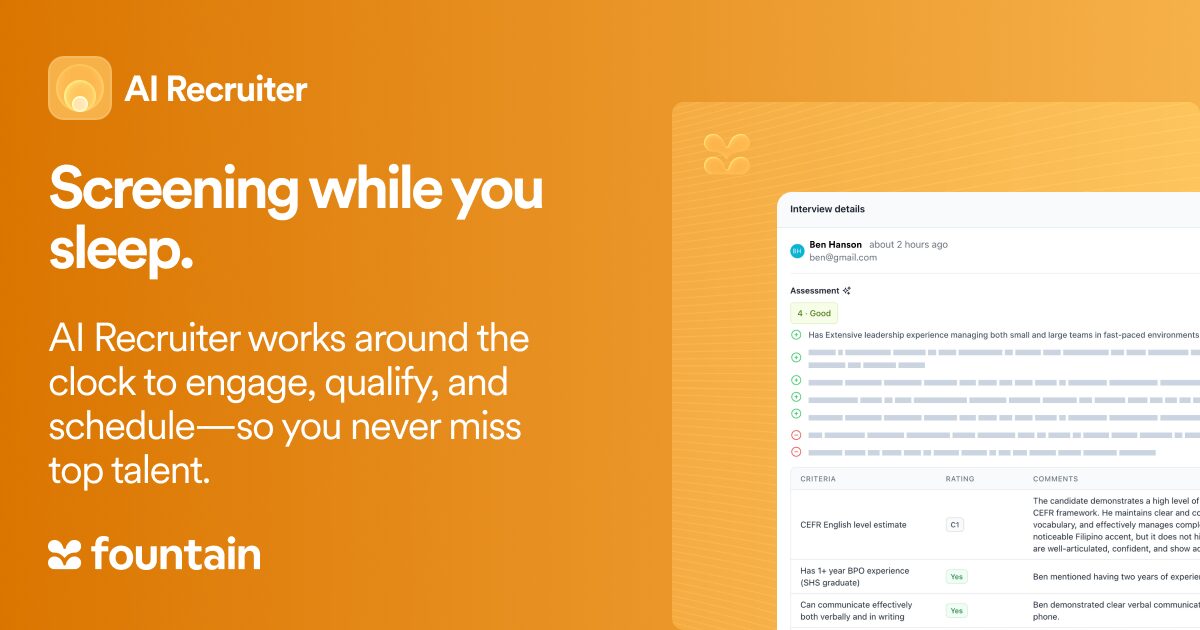
- Anna, the AI Recruiter, conducts voice interviews 24/7, scores candidates against role criteria, and surfaces qualified applicants for recruiter review.
- The Candidate AI Agent answers candidate questions around the clock via web, SMS, and WhatsApp, keeping hiring moving even when recruiters are offline. At every stage, humans retain the final call on hiring decisions.
Fountain’s full-lifecycle system covers sourcing and talent reactivation (Sourcing, CRM), applicant tracking (ATS), compliance and day one readiness (Onboarding), and shift management (Shift & Scheduling), all under one platform.
Filling shifts faster, reducing candidate drop-off, and getting new hires to onboarding without compliance errors requires a system that acts on your team’s behalf rather than waiting for manual input at every step. That’s what Fountain was built to do.
Book a demo to see how Fountain’s agentic AI platform works for frontline hiring at scale.
Frequently asked questions about agentic AI in frontline hiring
What is agentic AI in recruiting?
Agentic AI in recruiting refers to AI systems that execute multi-step hiring tasks (screening, scheduling, candidate engagement, follow-ups, and re-engagement) based on goals and parameters set by your team.
How is agentic AI different from a hiring chatbot?
A chatbot handles single-turn conversations and depends on human input to move between stages. Agentic AI operates across multiple steps: it can screen a candidate, schedule an interview, send reminders, reschedule if needed, and trigger onboarding, all without a recruiter initiating each action.
Is agentic AI compliant with hiring and data privacy laws?
Compliance depends on the system and how it’s deployed. Federal anti-discrimination law, state-level AI regulations, and the EU AI Act all apply. Any agentic AI system you evaluate should offer audit trails, bias testing across protected groups, human override capability at consequential decision points, and explainable outputs.