Most warehouse compliance guidance reads as an equipment problem. Most of what an employer actually gets penalized for is a document that was never delivered or a record nobody can produce on deadline: a forklift certification record, an employment eligibility form, or, in six states, a written description of the quota a worker is held to.
The Occupational Safety and Health Administration (OSHA) reissued its Warehousing and Distribution Center National Emphasis Program effective July 31, 2026, and it now runs through July 31, 2031.
The directive’s own Table 1 puts general warehousing and storage at 5.2 recordable cases per 100 full-time workers against 2.6 for all private industry, averaged across 2020 to 2024. Inspection readiness is a 5-year commitment now, and most of what it turns on sits with HR, not facilities.
What is warehouse worker compliance?
Warehouse worker compliance is the set of verifications, credentials, and disclosures an employer documents for every warehouse hire, and it stacks in three layers. Before the offer come background check authorizations and adverse action notices. Before the worker touches equipment come credentials like forklift certification and age eligibility.
At hire and afterward come employment eligibility forms, injury logs, and, in six states, a written production quota description.
Facility engineering sits outside that frame: machine guarding, lockout/tagout, and extinguisher placement belong to safety teams, while the documents below belong to HR and operations. Treat this as general orientation rather than legal advice, and confirm your obligations with counsel.
What changed in OSHA’s 2026 warehousing enforcement push
The reissued directive supersedes the July 13, 2023 version and changes three things that matter to a compliance plan. It runs a 5-year term rather than 3, it drops the ergonomic and heat hazard screening the old version made mandatory at every inspection, and it removes high-injury-rate retail establishments from coverage.
Any plan built around those two screens rests on a directive that no longer exists, though both hazards stay enforceable under the General Duty Clause.
Coverage runs from postal processing centers and courier operations through general, refrigerated, and other warehousing. OSHA publishes no ranked violation list, but its frequently cited standards tool, searchable by North American Industry Classification System (NAICS) code, puts the powered industrial truck standard at the top for warehousing and storage, ahead of hazard communication, exit routes, and lockout/tagout.
What has to be true before a warehouse worker’s first shift
Before a first shift, an employer generally needs its screening steps complete and, for anyone who will touch a lift truck, credentials and age eligibility verified.
Background checks run on the Fair Credit Reporting Act (FCRA) sequence: a standalone written disclosure and written authorization before the report is pulled, then a two-step pre-adverse and adverse action process if the results drive a no.
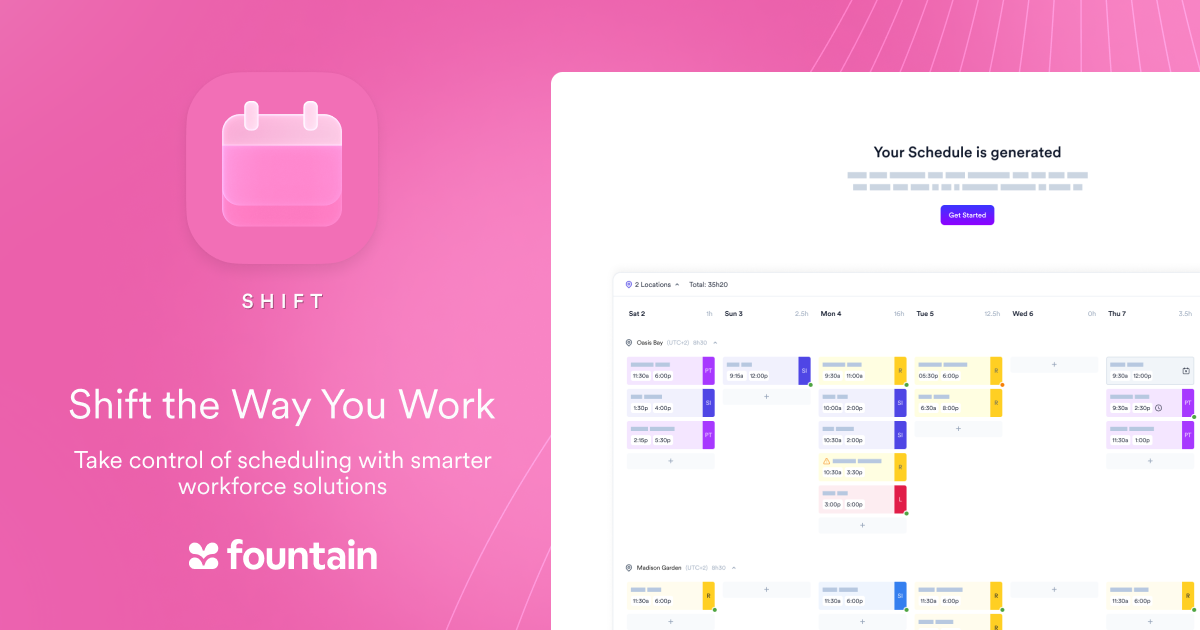
Smart, flexible scheduling built for frontline teams—because flexibility is essential, not optional.
Optimize your frontline workforce management with Fountain Shift—the all-in-one mobile scheduling solution designed to streamline operations and enhance employee satisfaction.
Automate shift creation, minimize errors, and empower your team with mobile access to schedules, time tracking, and seamless shift management. Experience the future of workforce scheduling today.
Ban-the-box laws move the point at which criminal history can be raised at all, on timing that varies by state and city. Fountain’s guide to pre-employment screening covers both in full.
Forklift certification under 29 CFR 1910.178(l)
Employers certify forklift operators. OSHA does not, and no OSHA-issued card exists. Under 29 CFR 1910.178(l), the certification record has to carry four elements: the operator’s name, the training date, the evaluation date, and the identity of whoever performed the training or evaluation.
No format is prescribed, so a log, cards, or electronic records all work if all four fields are present. Trainees may operate only under direct supervision, which OSHA reads as the qualified trainer being physically present for the practical training.
The record also carries a clock. Training itself does not expire, but the regulation requires a performance evaluation at least once every 3 years, which can be as informal as a qualified person watching typical operations and asking a few questions.
Five events trigger refresher training: unsafe operation is observed, the operator is in an accident or near-miss, an evaluation reveals unsafe operation, the operator is assigned a different type of truck, or workplace conditions change in a way that could affect safe operation.
Two controls follow. Keep equipment access closed until all four fields are complete, and alert on the 3-year evaluation date before it lapses rather than after a schedule is built around that operator.
The minimum age of 18 comes from the Wage and Hour Division
Federal law sets 18 as the minimum age for operating a forklift, but the rule is not OSHA’s. It lives in the Department of Labor’s child labor regulations at 29 CFR 570.58, administered by the Wage and Hour Division, and it reaches operating, tending, riding upon, repairing, and servicing high-lift trucks.
Minors cannot serve as spotters either.
The regulation does carve out low-lift trucks designed to move materials without tiering them, so a walkie pallet jack that lifts only far enough to clear the floor falls outside the ban. Equipment permissions should separate the two, with age verified before clearance.
What drug testing law actually requires
No federal law requires private employers to drug test warehouse workers. Department of Transportation testing follows the commercial driver’s license role operating commercial motor vehicles on public roads, so forklift operation alone does not trigger it.
OSHA’s October 11, 2018 interpretation permits post-incident testing but treats testing used to penalize injury reporting as a violation, and multi-state policies belong in front of employment counsel.
The warehouse-only rules most compliance guides miss
Six states now require covered warehouse employers to give each worker a written description of every quota they are held to at time of hire, plus notice when a quota changes, a retention window, and in most states a deadline for answering a worker’s request for their own work-speed data.
It is the one regime genuinely specific to warehouse work, and it lands as a document problem, not a safety one. The thresholds and clocks are not uniform, which is the difficulty when you are hiring across multiple states and sites.
| State | In effect | Single-site threshold | Worker data-request clock | Couriers (NAICS 492110) |
| California | Jan. 1, 2022 | 100 employees | 21 days | Not covered |
| New York | June 19, 2023 | 100 employees | 14 calendar days | Covered, drivers excluded |
| Minnesota | Aug. 1, 2023 | 250 employees | 4 business days | Covered |
| Washington | July 1, 2024 | More than 100 | 2 business days (description), 7 (data) | Not covered |
| Oregon | Jan. 1, 2025 | 100 employees | None stated; prior 90 days of data | Not covered |
| Connecticut | July 1, 2026 | 250 employees | Not specified | Covered, drivers excluded |
All six also trigger at 1,000 or more employees statewide, so a network of mid-sized buildings can be covered even where no single site clears the threshold. New York and Connecticut carve the drivers themselves out of their employee definitions, so hub workers and drivers have to be classified separately.
Oregon bars adverse action against a worker for missing a quota they never received in writing, which makes the delivery record the defense. Indoor heat rules vary the same way, and California’s standard is the one that names warehouses explicitly.
Three things are not law: the federal heat standard is still proposed, Illinois’s quota bill was vetoed in March 2025, and the federal Warehouse Worker Protection Act bills remain in committee.
What you have to be able to produce on demand
Every record above has a requester and, in most cases, a fixed window. Retrieving the right one before the clock runs out is a different problem from storing it.
- Form I-9, on 3 business days’ notice. Immigration and Customs Enforcement (ICE) can serve a Notice of Inspection, and retention runs 3 years from the first day of work or 1 year after separation, whichever is later, so each employee carries a different destruction date.
- A complete forklift certification record for every active operator. A compliance officer can ask during an inspection under the emphasis program, and a record missing one of the four fields is no record.
- Injury and illness logs, within 4 business hours. OSHA’s recordkeeping rule gives an authorized government representative 4 business hours, while employees get copies by the next business day, which is two queues rather than one. Warehousing is not on OSHA’s partially exempt list, and establishments in NAICS 4931 with 100 or more employees submit Forms 300, 300A, and 301 electronically by March 2 each year.
- A quota description for every covered worker in the six states. Minnesota and Connecticut also require updated information when a quota changes, Washington sets a 3-year retention period, and former employees in New York can request records for 3 years after separation.
- Work-speed data on the requesting state’s clock. Current workers, and former workers in several states, can ask for their own numbers, so each request has to route against the right state deadline.
The arithmetic makes this an operations problem rather than a filing one. A 1-in-100 miss rate is a single file at 100 hires in one building. At 10,000 hires across 30 sites in a dozen states, it leaves 100 files, each on a different clock and invisible until a notice arrives. Systems can flag missing fields and approaching expirations; people review the exceptions.
A regular HR compliance audit surfaces the gap before a regulator does.
How Fountain builds warehouse compliance into hiring and onboarding
Fountain treats this as one workflow rather than a set of files. Cue, the orchestration layer above every Fountain product, takes the request in plain language: “show me every forklift certification across our Midwest sites missing one of the four required fields, and flag anyone whose evaluation lapses before peak.”
The list comes back ready to work from, and a manager still approves every exception.
Cue coordinates a roster of agents, all live today. Emma, the I-9 and W-4 consultant, walks new hires through onboarding paperwork and answers the questions that stall document completion. Anna, the AI Recruiter, handles screening upstream, and Sam tracks post-hire signals.
Underneath, Fountain Onboarding holds the forms an employer has to produce inside ICE’s 3-business-day window and tracks completion by location, the ATS holds a candidate at the stage where a screening step or age check has to clear, and Shift & Scheduling carries multi-site coverage-gap detection and break and overtime rule logic.
With Fountain, Stitch Fix reported a 40% increase in applicants who pass background checks and show up on day one at its fulfillment centers, with a median time to hire of 9 days, down from nearly 3 weeks.
Warehouse compliance comes down to two questions: was the document delivered, and can the record be produced before the clock runs out. Those are properties of a workflow, not a filing cabinet. See it against your own record set.
Book a demo to watch Cue pull a certification-gap list across sites and Onboarding route a state-specific quota description to a covered hire.
Frequently asked questions about warehouse worker compliance
Warehouse compliance asks employers to document pre-hire screening, role credentials, employment eligibility, and state disclosures, then keep each record retrievable.
What does warehouse worker compliance cover?
Three layers of documentation follow each hire. Pre-offer verification covers background check disclosures and adverse action notices. Role credentials cover forklift certification and the minimum age of 18 for powered equipment, both verified before equipment access. Ongoing disclosure and retention covers Form I-9, injury logs, and state quota descriptions.
Does OSHA certify forklift operators?
No. The employer certifies each operator after training and evaluation under 29 CFR 1910.178(l)(6), and no OSHA-issued card exists. The record has to contain the operator’s name, the training date, the evaluation date, and the identity of the trainer or evaluator, so all four fields should be complete before the operator is cleared.
Which states have warehouse worker protection laws?
Warehouse quota-disclosure laws are in force in California, New York, Minnesota, Washington, Oregon, and Connecticut. All six require a written quota description at time of hire, but thresholds, response clocks, and courier coverage differ enough that covered hires generally need routing by work location.